When the grid flickers and your irrigation pumps grind to a halt, the difference between hybrid and off-grid architecture isn’t just technical—it determines whether you face crop loss or harvest security. For facility managers and EPC contractors balancing motor protection with capital expenditure, choosing the wrong inverter topology can drain battery banks prematurely or leave critical VFD-driven loads unprotected during extended outages.
Understanding where hybrid intelligence ends and true off-grid independence begins is essential for safeguarding both equipment lifespan and operational budgets. The wrong configuration turns your solar pump investment into a maintenance burden, while the right choice ensures predictable energy costs and reliable motor control across decades of agricultural or industrial use. This breakdown cuts through the specification sheets to reveal which solution actually protects your bottom line.
Hybrid Solar Inverter vs. Off-Grid Inverter: Technical Cost Analysis and Procurement Guide for Industrial Applications
Direct Engineering Comparison and Cost Breakdown
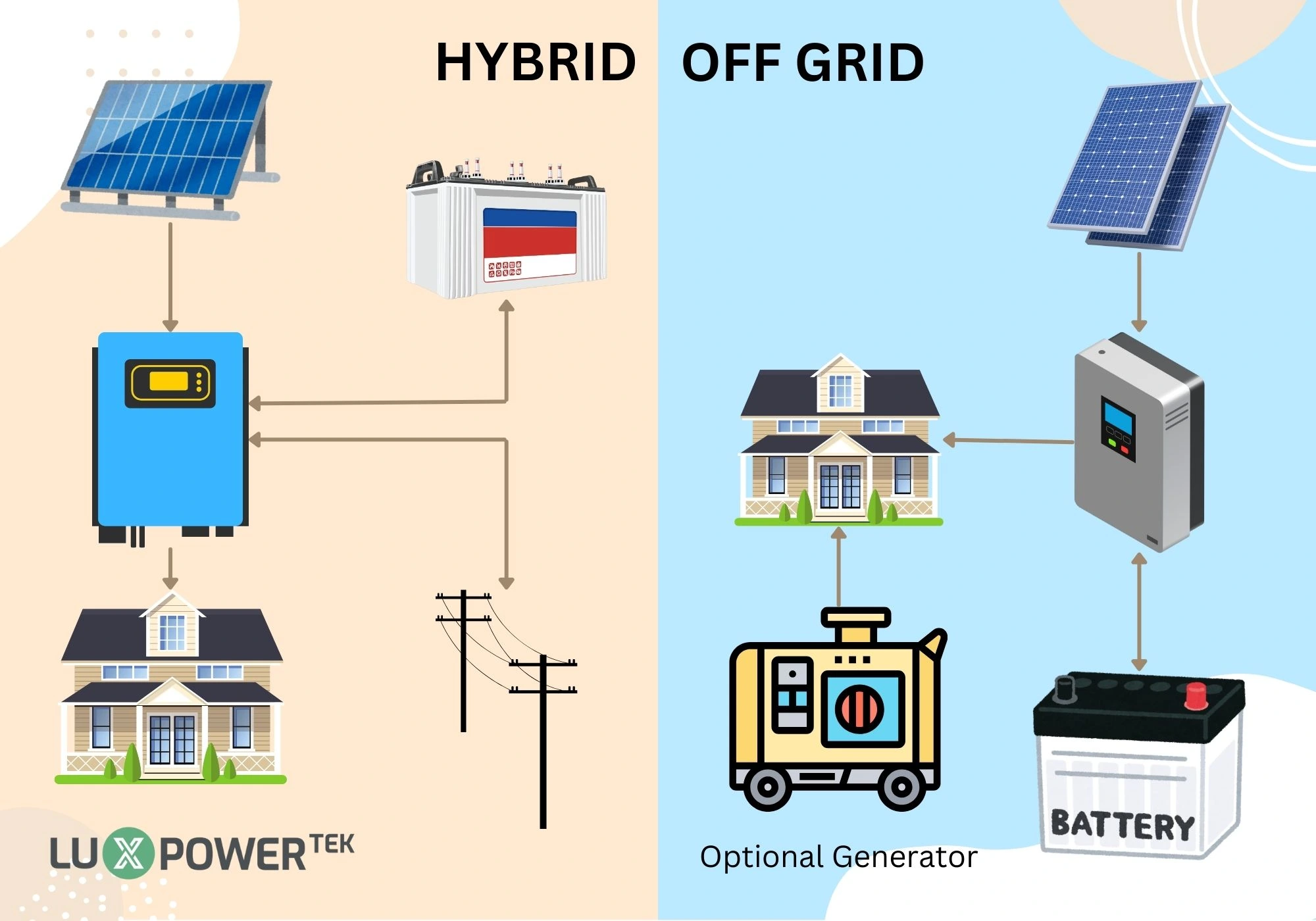
From a power electronics standpoint, the fundamental distinction lies in the bidirectional power flow capability. Hybrid solar inverters incorporate dual-stage conversion architecture (DC/AC/DC/AC) with grid-tie synchronization logic, while off-grid inverters operate as standalone DC/AC conversion units with battery priority management.

Cost Structure Analysis (Industrial Scale):
| Specification | Off-Grid Inverter | Hybrid Inverter | Cost Delta |
|---|---|---|---|
| 3-6kW Residential | $800-$1,500 | $1,200-$2,500 | +40-60% |
| 8-12kW Commercial | $1,800-$3,200 | $3,500-$6,000 | +50-90% |
| 16-30kW Industrial | $4,000-$7,500 | $8,000-$15,000 | +80-100% |
The premium for hybrid systems stems from additional hardware requirements: anti-islanding protection relays, grid synchronization PLL (Phase-Locked Loop) circuits, and advanced MPPT (Maximum Power Point Tracking) controllers with dual-string capability. For solar pumping applications specifically, off-grid configurations typically deliver superior ROI in remote agricultural installations where grid infrastructure is non-existent, whereas hybrid systems justify their cost premium in C&I (Commercial & Industrial) settings requiring peak shaving and grid backup functionality.
Critical Technical Factors Affecting Selection and Pricing
1. Power Topology and Phase Configuration
– Single-phase (220V/230V): Standard for residential systems up to 10kW. Off-grid units in this class utilize simpler H-bridge topologies, reducing BOM (Bill of Materials) cost by 15-20%.
– Split-phase (120/240V): Critical for North American markets. Hybrid split-phase inverters require neutral line management and dual-pole switching, increasing semiconductor count.
– Three-phase (380V/400V/480V): Industrial standard. Three-phase hybrid inverters incorporate IGBT modules with higher current ratings (600A-1200A) and sophisticated vector control algorithms, commanding 2.5x pricing over single-phase equivalents.
2. MPPT Efficiency and String Voltage
High-efficiency MPPT controllers (99% tracking efficiency vs. 97% standard) add $200-$400 to unit cost but improve energy harvest by 3-5% annually. For off-grid pumping systems, wide MPPT voltage ranges (150V-600VDC) enable direct PV coupling without DC-DC converters, reducing system complexity.
3. Environmental Protection Ratings
– IP20-IP32: Indoor installation, cost-effective for controlled environments.
– IP54-IP65: Essential for outdoor agricultural or desert installations. Hybrid units with IP65 ratings require conformal coating and sealed enclosures, adding 25-30% to manufacturing costs.
– IP66: Marine and harsh chemical environments. Off-grid inverters in this category often utilize passive cooling to eliminate fan failure points.
4. Vector Control and Motor Compatibility
For solar pump applications, the inverter’s motor control strategy determines system efficiency:
– V/f Control: Basic scalar control, suitable for centrifugal pumps. Cost-effective but poor torque response.
– Sensorless Vector Control (SVC): Required for submersible pumps with high starting torque. Adds $150-$300 to controller costs.
– Field-Oriented Control (FOC): Necessary for PMSM (Permanent Magnet Synchronous Motor) pumps. Hybrid inverters with FOC capability offer 15-20% higher efficiency in partial load conditions but require 32-bit DSP processors.
5. THD and Grid Code Compliance
Hybrid inverters must maintain THD (Total Harmonic Distortion) below 3-5% per IEEE 519/IEC 61000 standards, necessitating output filters and advanced PWM algorithms. Off-grid units face less stringent requirements (THD 50,000 hours).
Related Technical Insight
Boray Inverter: Your Strategic OEM/ODM Partner
Boray Inverter (borayinverter.com) stands at the forefront of solar pumping and motor control solutions, offering engineered advantages that differentiate us from commodity traders:
Engineering Excellence: With 50% of our workforce dedicated to R&D engineering, we possess deep mastery of PMSM and IM (Induction Motor) vector control algorithms, ensuring optimal torque production for high-head solar pumps and precision VFD applications.
Manufacturing Integrity: Our facility operates two modern production lines with automated assembly and testing stations. Every unit undergoes 100% full-load testing at 110% rated current for 2 hours before delivery, eliminating infant mortality and ensuring specification compliance.
Technical Specifications: Our solar pump inverters feature:
– Wide MPPT voltage range (200V-800VDC) for flexible string design
– IP65 enclosure options for harsh agricultural environments
– Advanced MPPT algorithms with <1% power loss tracking accuracy
– Soft-start functionality reducing mechanical stress on pump systems
Whether you require standard solar pump inverters, hybrid energy storage solutions, or custom VFDs with specific communication protocols, Boray delivers wholesale pricing and tailored engineering support. Contact Boray today to discuss your project specifications and receive competitive OEM/ODM quotations.
Frequently Asked Questions (FAQs)
Can an off-grid inverter be upgraded to hybrid functionality later?
Generally, no. Off-grid inverters lack the grid-synchronization hardware (anti-islanding relays, voltage/frequency detection circuits) and bidirectional metering capabilities required for grid-tie operation. Retrofitting would require replacing the entire inverter chassis. For projects anticipating future grid connection, specify a hybrid inverter with “off-grid mode” capability from inception.
What MPPT voltage range is optimal for solar pumping systems?
For submersible pumps requiring high starting torque, select inverters with MPPT ranges starting below 200VDC to ensure operation during low-irradiance morning periods. For surface pumps, higher voltage ranges (400V-800VDC) reduce copper losses in DC cabling. Always verify the Voc (Open Circuit Voltage) of your PV array does not exceed the inverter’s maximum input voltage by more than 10% to account for cold-weather voltage spikes.
How do I size an inverter for high-inertia pump loads?
High-inertia loads (deep well submersibles, large centrifugal pumps) require inverters with 150% overload capacity for 60 seconds minimum. Verify the VFD utilizes sensorless vector control or FOC (Field-Oriented Control) rather than basic V/f control to maintain 150% starting torque at 0.5Hz. For solar pumps, ensure the inverter includes “dry-run” protection and flow sensor integration.
What is the expected service life and warranty structure for industrial solar inverters?
Quality inverters utilize electrolytic capacitors rated for 100,000 hours at rated temperature (typically 85°C). Under normal operating conditions (40°C ambient), expect 10-15 years service life. Standard warranty terms are 5 years for hybrid inverters and 2-3 years for off-grid units, with extensions available for large-scale procurement. Verify the manufacturer maintains local service centers or advanced replacement programs to minimize downtime.
Which certifications are mandatory for international project financing?
For grid-tied hybrid systems, IEC 62109-1/-2 (safety), IEC 61683 (efficiency), and IEEE 1547/UL 1741 (grid interconnection) are standard requirements. Off-grid systems for rural electrification typically require IEC 62040 (UPS safety) and IEC 61215 (if integrated PV). For solar pumping projects, verify compliance with IEC 60034-30-1 (motor efficiency classes) if the inverter and motor are bundled. CE marking is mandatory for European markets; UL listing for North America.