Your motors are running marathons when they should be jogging—and your energy bill shows it. Across factories and farms, electric motors consume up to 60% of operational power, yet most run at fixed speeds regardless of actual demand, bleeding efficiency and shortening equipment life with every unnecessary rotation.
Understanding how Variable Frequency Drives manipulate electrical frequency to match motor speed with real-time load requirements isn’t just technical trivia—it’s the difference between sustainable operations and spiraling costs. For facility managers watching margins tighten and EPC contractors promising ROI, mastering VFD fundamentals unlocks precise control, dramatic energy savings, and extended motor longevity.
This article breaks down exactly how these devices convert fixed AC power into adjustable frequencies, transforming your rotating equipment from constant energy drains into responsive, intelligent assets.
How Variable Frequency Drives Work: AC-DC-AC Power Conversion Topology
A Variable Frequency Drive (VFD) operates on the fundamental principle of AC-DC-AC power conversion with Pulse Width Modulation (PWM). The drive receives fixed-frequency AC input (typically 50Hz or 60Hz), converts it to DC via a rectifier bridge, filters it through a DC bus capacitor bank, and inverts it back to variable-frequency AC using high-speed switching IGBTs (Insulated-Gate Bipolar Transistors).
The rectifier section utilizes six-pulse diode bridges or active front-end (AFE) converters to transform alternating current into direct current with an AC ripple. The DC link section employs electrolytic capacitors and DC reactors to smooth this ripple, maintaining a stable DC bus voltage (typically 1.35 × input AC voltage for three-phase systems). The inverter section then switches the DC voltage using IGBT transistors at carrier frequencies ranging from 2kHz to 16kHz, generating a PWM waveform that simulates a sinusoidal AC output.
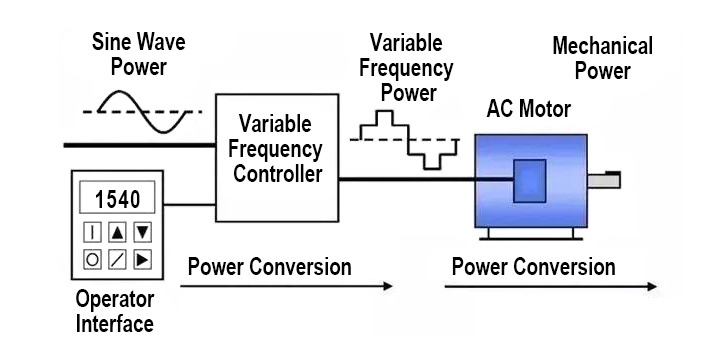
Motor speed control follows the synchronous speed formula N = 120 × f / P, where N represents rotational speed (RPM), f represents frequency (Hz), and P represents the number of motor poles. By varying the output frequency while maintaining a constant Volts-per-Hertz (V/Hz) ratio, the VFD delivers proportional voltage reduction as frequency decreases, ensuring constant torque capability and preventing motor saturation.
Technical Factors Affecting VFD Pricing and Selection
Power Rating and Voltage Class
VFD costs scale exponentially with power capacity. Units below 7.5kW utilize single-phase 220V or three-phase 380V inputs, while industrial applications above 75kW require 480V, 690V, or medium voltage (2.3kV-13.8kV) configurations. High-voltage drives incorporate series-connected IGBT modules or multi-level topologies, significantly increasing component costs.

Control Methodology
- Scalar Control (V/Hz): Cost-effective open-loop control suitable for pumps and fans; maintains constant flux by keeping voltage proportional to frequency.
- Sensorless Vector Control: Utilizes motor model algorithms to estimate rotor position without encoder feedback; provides 1:100 speed range and 150% starting torque at 0.5Hz.
- Closed-Loop Vector Control: Requires encoder/resolver feedback; achieves 1:1000 speed range, zero-speed holding torque, and precise torque control for hoisting applications.
- Direct Torque Control (DTC): Advanced algorithm eliminating modulator stage; provides 35%), adding 15-25% to base cost but eliminating need for external harmonic filters.
Communication and I/O Capabilities
Integrated PLC functions, safety STO (Safe Torque Off) circuits, and industrial Ethernet protocols (Profinet, EtherCAT, Modbus TCP) add incremental costs but reduce external control hardware requirements.
Practical Sizing and Sourcing Guidelines for Industrial Buyers
Motor Nameplate Verification
Before procurement, verify the motor’s Full Load Amps (FLA), service factor (typically 1.15 or 1.25), insulation class (F or H required for inverter duty), and base speed. Size the VFD current rating at minimum 110% of motor FLA for constant torque applications, or 100% for variable torque loads. Never size based solely on horsepower ratings due to varying motor efficiencies across manufacturers.
Load Profile Analysis
Variable Torque Loads (centrifugal pumps, fans): Follow the affinity laws where power varies with the cube of speed; 20% speed reduction yields 50% energy savings. Standard V/Hz control suffices.
Constant Torque Loads (conveyors, extruders, compressors): Require heavy-duty ratings with 150% overload capacity for 60 seconds. Specify vector control for low-speed high-torque operation.
Regenerative Loads (cranes, downhill conveyors): Require braking resistors or regenerative front ends to dissipate kinetic energy; calculate braking duty cycle (ED%) based on deceleration time versus cycle time.
Installation Considerations
- Input Line Reactors: Specify 3% impedance reactors when line voltage imbalance exceeds 2% or when multiple drives share a common bus.
- Output Filtering: For cable runs exceeding 50 meters, specify dV/dt filters or sinusoidal filters to prevent reflected wave phenomena that damage motor insulation.
- Environmental Derating: Apply 1% current derating for every 100m above 1000m altitude; derate 2.5% for every 1°C above 40°C ambient.
Avoiding Common Procurement Failures
Reject drives lacking full-load burn-in testing documentation. Verify that the VFD’s switching frequency is adjustable to accommodate motor cable capacitance. For solar pump applications, confirm Maximum Power Point Tracking (MPPT) voltage range matches photovoltaic array characteristics (typically 200V-800VDC for 380V AC pumps).
Why Source Inverters and VFDs from China?
China maintains the world’s most advanced power electronics manufacturing ecosystem, offering distinct competitive advantages for B2B procurement:
Integrated Supply Chain Verticalization: Chinese manufacturers control the entire value chain from silicon wafer processing (IGBT/MOSFET die production) to final assembly, reducing lead times from 12 weeks to 3-4 weeks for custom configurations.
Advanced R&D Infrastructure: Leading Chinese drive manufacturers now operate Level 4 automated production lines with robotic PCB assembly and AI-driven testing protocols. Domestic engineering teams specialize in high-efficiency topologies including SiC (Silicon Carbide) MOSFET implementations achieving 99% efficiency and three-level NPC (Neutral Point Clamped) inverters for medium voltage applications.
Related Technical Insight
Cost Optimization Without Quality Compromise: Direct sourcing eliminates distributor markups (typically 25-40% in Western markets) while maintaining CE, UL, and IEC 61800 compliance. Chinese factories offer MOQ flexibility starting at 10 units for OEM branding versus 500+ unit requirements from European manufacturers.
Customization Agility: Chinese OEMs provide rapid firmware customization for specialized applications—such as agricultural irrigation control algorithms or compressor anti-surge routines—within 2-3 weeks development cycles versus 3-month timelines elsewhere.
Boray Inverter: Your Strategic OEM/ODM Partner for Motor Control Solutions
Boray Inverter (borayinverter.com) represents the convergence of Chinese manufacturing efficiency and precision engineering excellence. As a specialized manufacturer of Solar Pump Inverters and Variable Frequency Drives, Boray offers distinct technical advantages for industrial buyers and system integrators:
Engineering-First Organization: With 50% of our workforce dedicated to R&D engineering, Boray maintains proprietary firmware algorithms for both PMSM (Permanent Magnet Synchronous Motor) and IM (Induction Motor) vector control systems. Our drives achieve 0.5Hz/150% starting torque without encoder feedback, critical for deep-well solar pumping applications.
Manufacturing Excellence: Our facility operates two fully automated SMT production lines with X-ray inspection and automated optical inspection (AOI) systems. Every unit undergoes 100% full-load testing at 45°C ambient for 4 hours before shipment, ensuring zero field failures due to thermal stress or component defects.
Application Specialization: Boray excels in harsh-environment VFDs with IP66 aluminum die-cast enclosures for agricultural irrigation, integrated MPPT controllers for solar pumping (98.5% tracking efficiency), and specialized braking algorithms for crane and hoist applications.
Partnership Advantages: We provide comprehensive OEM/ODM services including silkscreen branding, custom parameter default settings, and communication protocol integration (Modbus, CANopen). Our wholesale pricing structure eliminates intermediary costs, delivering premium vector-control drives at standard scalar-control market prices.
Contact Boray Inverter today to discuss your specific motor control requirements, request sample units for validation testing, or receive detailed ROI calculations for your pumping or industrial automation projects.
Frequently Asked Questions (FAQs)
What is the difference between a VFD and a Soft Starter?
A Soft Starter temporarily reduces voltage during motor startup using thyristors, limiting inrush current to 3-4 times FLA but always running the motor at full speed. A VFD provides full speed control (0-400Hz typically) by varying frequency and voltage, offering energy savings proportional to speed reduction. Soft starters suit fixed-speed applications requiring only reduced starting torque; VFDs are required for any variable speed or energy optimization application.
Can I install a VFD on any existing AC motor?
Standard motors require inverter-duty insulation (Class F or H with phase-to-phase voltage rating ≥1600V) to withstand PWM voltage spikes. Motors manufactured before 1995 often lack sufficient insulation for modern IGBT drives with 750VDC on 380V AC systems) occur when the motor acts as a generator during rapid deceleration, pumping energy back into the DC bus faster than the capacitors can absorb or the braking resistor can dissipate. Solutions include: increasing deceleration ramp time, installing appropriately sized braking resistors (calculate using E = ½Jω² for system inertia), or enabling stall prevention (flux braking) algorithms in the VFD parameters.
How do I calculate energy savings for a pump or fan application?
For centrifugal loads, use the Affinity Laws: Power varies with the cube of speed (P ∝ N³). A pump running at 80% speed consumes 51.2% power (0.8³). Subtract VFD losses (3-5%) and multiply by operating hours and electricity cost. Example: A 75kW pump operating 6000 hours/year at 80% duty saves approximately: 75kW × (1-0.512) × 6000h × $0.12/kWh = $26,352 annually, typically achieving ROI within 8-14 months.
Can a VFD convert single-phase input to three-phase output?
Yes, but with limitations. Single-phase input VFDs up to 3.7kW (5HP) can generate three-phase output by utilizing a voltage-doubling rectifier circuit (boosting 220V single-phase to 310VDC bus). However, single-phase input creates higher ripple current, requiring 30-50% current derating. For motors above 3.7kW, use a phase converter or specify drives with active power factor correction (PFC) front ends designed specifically for single-phase to three-phase conversion.