Every unplanned stop on your production line or irrigation system starts with a physics problem: where does all that kinetic energy go when your motor decelerates? Without properly sized braking resistors, that energy becomes destructive heat, premature drive failures, and costly downtime—turning your VFD investment into a maintenance liability.
For facility managers balancing energy budgets and EPC contractors guaranteeing system reliability, resistor calculation isn’t merely a technical specification. It’s the critical buffer between safe energy dissipation and catastrophic equipment damage. Size it wrong, and you either risk brake chopper failure from insufficient thermal capacity or waste capital on oversized units that drain your project margins.
Mastering the math behind braking resistor selection protects both your hardware and your profitability. Here’s how to calculate the optimal specifications for reliable, cost-effective motor control.
How to Calculate Braking Resistor for VFD: Technical Specifications and Cost Factors
Direct Engineering Answer: Braking Resistor Calculation Methodology
The calculation of braking resistor specifications for Variable Frequency Drives (VFDs) requires determining three critical parameters: duty cycle, power dissipation capacity, and resistance value.
Duty Cycle Calculation:
Duty Cycle (%) = (Braking Time / (Braking Time + Rest Time)) × 100%
For example, if a conveyor system decelerates for 3 seconds within a 20-second operational cycle, the duty cycle equals 15% (3/20).
Power Dissipation (Wattage) Calculation:
First, determine the deceleration torque using:
Deceleration Torque = (ΔRPM × Load Inertia) / (308 × Deceleration Time) - Friction Torque
Where ΔRPM represents the speed change, inertia is in lb·ft² or kg·m², and time is in seconds.
Then calculate required wattage:
Watts = Deceleration Torque × (Start RPM + End RPM) × Duty Cycle × 0.0712
The constant 0.0712 converts units to watts when speeds are in RPM.
Critical Cost Consideration: Always apply a 20-25% safety margin to calculated wattage. Multiply your result by 1.20–1.25 to prevent thermal overload and ensure longevity. Undersizing by even 10% can result in catastrophic resistor failure and VFD overvoltage trips.
Resistance Value Determination:
Calculate minimum resistance using Ohm’s Law:
R_min = V² / P
Where V is the DC bus voltage (typically 700–800VDC for 400V-class drives) and P is the braking power. Select a resistor with 20% higher resistance than the minimum (R = 1.2 × R_min) to protect the VFD’s braking transistor from excessive current.
Technical Factors Affecting Pricing and Selection
1. Power Rating and Thermal Capacity
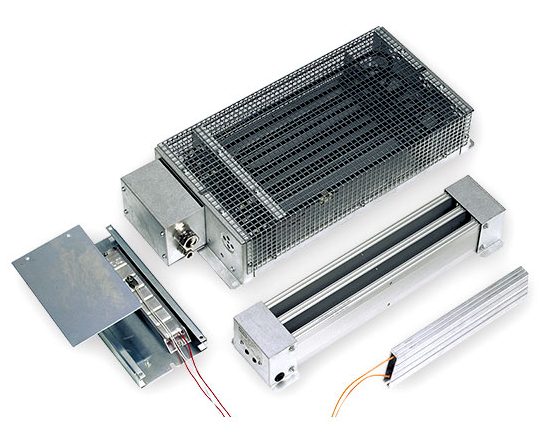
Braking resistors are priced primarily by their continuous power dissipation (P_cont) and peak power handling. Industrial-grade resistors rated for 1000W continuous operation cost significantly more than 300W units. High-duty-cycle applications (elevators, cranes) require resistors with aluminum housings or stainless steel enclosures for enhanced heat dissipation.
2. Duty Cycle Classification
– Light Duty (≤10%): Intermittent braking, centrifuges, fans
– Medium Duty (10-40%): Conveyors, machine tools
– Heavy Duty (≥40%): Hoisting applications, continuous lowering operations
Heavy-duty resistors command 30-50% price premiums due to enhanced thermal mass and wire-wound construction.
3. Resistance Precision and Temperature Coefficients
Standard resistors offer ±5% tolerance, but precision applications requiring ±1% tolerance increase procurement costs by 15-20%. Temperature coefficients affect performance in environments exceeding 40°C ambient.
4. Environmental Protection Ratings
– IP20: Basic protection for electrical cabinets, lowest cost
– IP54: Dust and splash protection for harsh industrial environments
– IP65: Complete dust and water jet protection for outdoor or washdown applications
Each IP rating increment typically adds 10-15% to unit cost but prevents premature failure in contaminated environments.
5. Application-Specific Requirements
Hoisting and lift applications require vector control drives with encoder feedback (not V/Hz open-loop), necessitating higher-specification braking systems. The resistor must handle sustained regenerative energy during lowering operations, often requiring 2-3x the wattage rating of horizontal motion applications.
6. Braking Transistor Compatibility
The resistor must match the VFD’s chopper circuit specifications. Exceeding the maximum current rating of the braking transistor (typically 50-150% of drive rated current) will damage the VFD’s internal circuitry.
Practical Sizing and Sourcing Guidelines for Industrial Buyers
Step-by-Step Sizing Protocol:
1. Calculate Duty Cycle: Document actual braking time versus total cycle time under worst-case operating conditions.
2. Determine Peak Braking Power: Use the deceleration torque formula or manufacturer-provided motor inertia data.
3. Select Resistance Range: Verify the calculated R_min against VFD manufacturer specifications. Never go below the stated minimum resistance.
4. Apply Environmental Derating: For ambient temperatures above 40°C or altitudes above 1000m, increase wattage rating by an additional 10-15%.
5. Specify Thermal Protection: Install normally-closed (NC) thermal switches linked to the drive’s coast-stop or emergency stop circuit to prevent fire hazards.
Sourcing Strategy to Optimize ROI:
– Manufacturer vs. Third-Party: While OEM resistors offer guaranteed compatibility, third-party resistors from specialized manufacturers can reduce costs by 20-30% provided they match resistance ranges and wattage requirements exactly.
– Bulk Procurement: Braking resistors for multiple VFD installations should be sourced as a consolidated package to leverage volume pricing on high-wattage units.
– Verification Protocol: Demand 100% full-load testing certificates from suppliers. Resistors should undergo pulse-power testing simulating actual braking cycles before delivery.
Installation Criticalities:
– Mount resistors in ventilated areas with minimum 150mm clearance from cabinet walls
– Use insulated tools during installation with power completely isolated
– Verify terminal torque specifications to prevent high-resistance connections that generate localized heating

Why Source Inverters/VFDs from China?
Related Technical Insight
China has emerged as the global hub for advanced motor control technology, offering distinct advantages for B2B procurement:
Advanced R&D Integration: Leading Chinese manufacturers now maintain engineering teams where 50% or more of personnel are dedicated R&D engineers, focusing on vector control algorithms, MPPT efficiency optimization for solar applications, and IoT integration.
Manufacturing Cost Efficiency: Direct sourcing from Chinese factories eliminates distributor markups (typically 25-40% in Western markets) while maintaining IEC and UL certification standards. Modern production facilities utilize automated winding equipment and robotic assembly lines that ensure consistency across large production runs.
Customization Capabilities: Chinese OEM/ODM partners offer rapid prototyping for application-specific requirements, including custom resistance values, specialized enclosures for marine or desert environments, and integrated thermal monitoring systems.
Quality Assurance Evolution: Tier-1 Chinese manufacturers now implement 100% full-load testing protocols, burn-in testing, and automated optical inspection (AOI) that match or exceed Western manufacturing standards.
Boray Inverter: Your Strategic OEM/ODM Partner
Boray Inverter stands at the forefront of motor control innovation, specializing in Solar Pump Inverters and Variable Frequency Drives engineered for demanding industrial applications worldwide.
Technical Excellence: With a workforce comprising 50% R&D engineers, Boray has mastered advanced control methodologies including PMSM (Permanent Magnet Synchronous Motor) and IM (Induction Motor) vector control, ensuring precise torque management and energy efficiency across all operating speeds.
Manufacturing Infrastructure: Our facility operates two modern production lines equipped with automated testing stations. Every VFD undergoes 100% full-load testing before delivery, simulating real-world braking scenarios to verify DC bus regulation and braking transistor functionality.
Comprehensive Solutions: From standard dynamic braking resistors to integrated regenerative braking systems, Boray provides complete motor control solutions tailored to your specific duty cycle requirements and environmental constraints.
Partnership Benefits: We offer competitive wholesale pricing for volume orders, custom firmware development for specialized applications, and dedicated technical support for braking resistor sizing calculations.
Contact Boray Inverter today to discuss your project requirements and discover how our engineering expertise can optimize your motor control systems while reducing total cost of ownership.
Frequently Asked Questions (FAQs)
What is the difference between dynamic braking and DC braking in VFD applications?
Dynamic braking utilizes an external resistor to dissipate regenerative energy as heat during high-speed deceleration, handling substantial power levels. DC braking applies direct current to the motor stator windings to create stationary magnetic fields that oppose rotation, suitable only for low-speed holding and stopping. DC braking cannot handle the energy dissipation requirements of rapid deceleration from high speeds and is typically used for positioning accuracy rather than dynamic stopping.
How do I prevent overvoltage faults when sizing braking resistors for lifting applications?
Lifting applications require sizing the drive and braking resistor for the worst-case load direction—typically the lowering direction plus full load inertia. Calculate inertia for both upward and downward directions, as gravitational forces drive the motor during descent. Use vector control with encoder feedback rather than V/Hz open-loop control, and specify a braking resistor with at least 40% duty cycle rating. Failure to size for lowering operations results in sustained overvoltage conditions that standard 10-20% duty cycle resistors cannot handle.
Can I use a third-party braking resistor with my existing VFD, or must I use the manufacturer’s specified unit?
Third-party resistors are acceptable provided they strictly conform to the VFD manufacturer’s resistance range (ohms) and minimum/maximum current ratings. Verify the resistor’s power dissipation rating matches or exceeds your calculated requirements including the 1.25 safety factor. However, manufacturer-provided resistors offer guaranteed thermal protection integration and warranty coverage. When using third-party resistors, ensure they include UL508A or CE certification and thermal cutoff switches to prevent fire hazards during failure modes.
Why does my braking resistor overheat even though calculations indicate adequate sizing?
Overheating typically results from underestimating the actual duty cycle in real-world operation, inadequate ventilation (insufficient heat sinking or cabinet cooling), or resistance values drifting above specifications due to temperature coefficients. Verify that the actual braking time per cycle matches your calculations—frequent emergency stops can increase duty cycle dramatically. Additionally, check terminal connections for looseness, which creates localized heating that mimics resistor overload. Install thermal monitoring switches to detect overheating before resistor failure.
What is the economic trade-off between braking resistors and regenerative braking units for high-duty-cycle applications?
For duty cycles exceeding 60% or continuous regenerative operation, regenerative braking units (active front-end drives) provide superior ROI despite 3-5x higher initial cost. Resistors dissipate energy as waste heat, incurring ongoing energy costs and requiring cooling infrastructure. Regenerative units return energy to the grid, reducing electricity consumption by 15-30% in high-cyclic applications. Calculate the break-even point based on your energy costs: typically, applications with continuous lowering operations or frequent deceleration cycles exceeding 100 times per hour justify the premium for regenerative solutions over dissipative resistor braking.