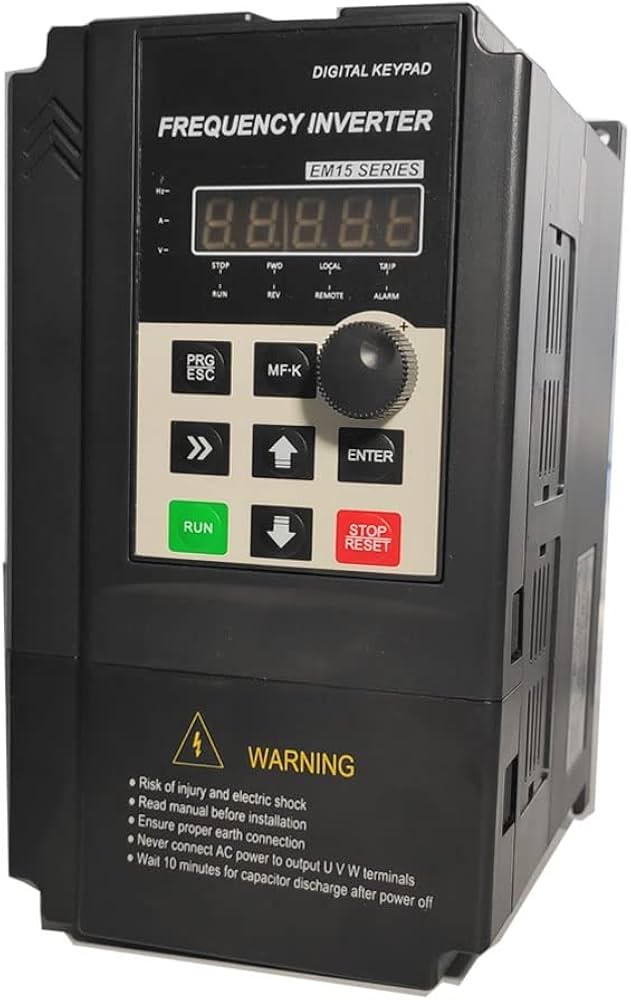
Introduction: Sourcing Variable Frequency Drive Single Phase Output for Industrial Use
In industrial automation and agricultural infrastructure, the efficient control of single-phase motors remains a critical yet often overlooked challenge. While three-phase systems dominate heavy industrial applications, countless operations—from remote solar pumping stations to precision HVAC systems and food processing conveyors—rely on single-phase asynchronous motors that demand sophisticated speed control solutions. Variable Frequency Drives (VFDs) with single-phase output capability bridge this gap, offering precise flux vector control and energy optimization for capacitor-start and split-phase motors where traditional three-phase VFDs fall short.
This comprehensive guide addresses the technical complexities facing engineers, EPC contractors, and automation distributors when sourcing single-phase output VFDs for demanding industrial environments. We examine the critical distinctions between single-phase input/output configurations and phase-conversion alternatives, analyzing power ranges from fractional horsepower to 10HP (7.5kW) systems. The content explores essential specifications including true two-phase orthogonal flux vector control, V/Hz characteristics, and capacitor-handling methodologies that determine compatibility with existing motor installations.
Beyond theoretical frameworks, we evaluate manufacturer capabilities, OEM integration requirements, and solar pumping applications where single-phase VFDs enable off-grid agricultural automation. Whether retrofitting legacy equipment or specifying drives for new solar-powered irrigation projects, understanding the nuances of single-phase motor control—from wiring configurations that eliminate start capacitors to IP ratings for harsh environments—is essential for maximizing operational efficiency, reducing maintenance costs, and ensuring reliable equipment longevity in your next industrial deployment.
Article Navigation
- Top 5 Variable Frequency Drive Single Phase Output Manufacturers & Suppliers List
- Introduction: Sourcing Variable Frequency Drive Single Phase Output for Industrial Use
- Technical Types and Variations of Variable Frequency Drive Single Phase Output
- Key Industrial Applications for Variable Frequency Drive Single Phase Output
- Top 3 Engineering Pain Points for Variable Frequency Drive Single Phase Output
- Component and Hardware Analysis for Variable Frequency Drive Single Phase Output
- Manufacturing Standards and Testing QC for Variable Frequency Drive Single Phase Output
- Step-by-Step Engineering Sizing Checklist for Variable Frequency Drive Single Phase Output
- Wholesale Cost and Energy ROI Analysis for Variable Frequency Drive Single Phase Output
- Alternatives Comparison: Is Variable Frequency Drive Single Phase Output the Best Choice?
- Core Technical Specifications and Control Terms for Variable Frequency Drive Single Phase Output
- Future Trends in the Variable Frequency Drive Single Phase Output Sector
- B2B Engineering FAQs About Variable Frequency Drive Single Phase Output
- Disclaimer
- Conclusion: Partnering with Boray Inverter for Variable Frequency Drive Single Phase Output
Technical Types and Variations of Variable Frequency Drive Single Phase Output
Single-phase output VFDs represent a specialized evolution in motor control technology, engineered to address the unique electromagnetic constraints of single-phase induction motors. Unlike their three-phase counterparts, single-phase motors historically rely on capacitive phase-shift or shaded-pole techniques to generate the rotating magnetic field necessary for torque production. Modern VFDs supersede these passive mechanical methods with active electronic phase generation, utilizing advanced PWM algorithms to create true two-phase orthogonal flux vectors. The following classifications delineate the primary technical architectures by input configuration, motor interface methodology, and application environment.
| Type | Technical Features | Best for (Industry) | Pros & Cons |
|---|---|---|---|
| Capacitor-Less Flux Vector (1φ→1φ) | • Removes motor start/run capacitors • IGBT-generated 90° orthogonal flux vectors • True 2-phase vector control (SVC/FOC) • 0-220V variable output, 0-400Hz range |
Agricultural pumping, HVAC retrofits, food processing conveyors | Pros: 150-200% starting torque, eliminates capacitor failure modes, stepless speed control Cons: Requires motor terminal box rewiring, incompatible with shaded-pole motors, needs parameter auto-tuning |
| Capacitor-Retention V/Hz (1φ→1φ) | • Maintains existing motor capacitor infrastructure • Simple Volts-per-Hertz control • Limited speed range (typically 2:1) • Forward/reverse via physical wiring swap |
Centrifugal fans, small air compressors, light-duty machine tools | Pros: Plug-and-play retrofit, no motor modification required, cost-effective Cons: Capacitor aging issues persist, limited low-speed torque, restricted speed range to avoid resonance |
| Solar DC-to-Single-Phase VFD | • MPPT algorithm for PV arrays (200-400VDC input) • Battery backup integration capable • Dry-run detection via current signature analysis • Automatic power derating on low irradiance |
Off-grid irrigation, remote livestock watering, rural water supply | Pros: Grid-independent operation, optimized solar harvesting, 3-5% higher efficiency vs. AC-fed drives Cons: Weather-dependent output, requires PV array oversizing, battery costs if continuous operation needed |
| Split-Phase 120V/240V VFD | • Dual voltage output with neutral utilization • Phase balancing for 120V control circuits • NEMA 5-15/6-15 compatible • Active Front End (AFE) for neutral current management |
North American residential, light commercial workshops, small business machinery | Pros: Compatible with standard US split-phase infrastructure, flexible voltage output Cons: Limited to <3HP due to single-phase input current constraints, requires dedicated neutral conductor |
| Three-Phase Input to Single-Phase Output | • 380-480V 3-phase input, 220-240V 1-phase output • Phase loss protection and ride-through • Synthesized single-phase via specialized PWM • Industrial-grade EMI filtering |
Industrial facilities with 3-phase supply but legacy 1-phase equipment, manufacturing plants | Pros: Utilizes existing 3-phase infrastructure, superior voltage stability during motor starting Cons: Requires 3-phase availability, higher installation complexity, potential phase imbalance if not properly configured |
Capacitor-Less Flux Vector Control (1φ Input → 1φ Output)
This architecture represents the highest performance tier for single-phase motor control, eliminating the mechanical failure points inherent in capacitor-start and capacitor-run motors. By removing the electrolytic start/run capacitors and connecting the motor’s main and
Key Industrial Applications for Variable Frequency Drive Single Phase Output
Single phase output Variable Frequency Drives (VFDs) serve as critical enablers for energy efficiency in infrastructure where three-phase power distribution is unavailable or cost-prohibitive to install. Unlike conventional three-phase VFDs, these specialized drives employ advanced flux vector control algorithms—specifically orthogonal 90° flux vector management—to address the unique torque pulsations and high inrush currents characteristic of single-phase asynchronous motors, including capacitor-start and capacitor-run designs. For EPC contractors and automation engineers, these devices offer a retrofit pathway to precision motor control and solar integration without requiring grid infrastructure upgrades.
The following table outlines primary industrial deployment scenarios, quantifiable efficiency gains, and critical technical specifications for sourcing decisions:
| Sector | Application | Energy Saving Value | Sourcing Considerations |
|---|---|---|---|
| Agricultural Irrigation & Solar Pumping | Surface pumps, borehole pumps, drip irrigation systems | 30–50% reduction in energy consumption; elimination of water hammer; optimized PV array utilization via DC bus input capability | IP65/NEMA 4X enclosure for outdoor exposure; compatibility with capacitor-start motor topologies (capacitor bypass/removal capability); MPPT integration for solar hybrid operation; high starting torque (>150% rated) for deep well applications |
| HVAC & Building Automation | Supply/exhaust fans, air handling units (AHUs), small circulation pumps | 20–40% fan energy savings via variable airflow control; reduced mechanical wear from soft-start capability; precise static pressure maintenance | Low electromagnetic interference (EMI) for BMS compatibility; BACnet/Modbus RTU communication protocols; compact DIN-rail or wall-mount options for control panel integration; automatic carrier frequency adjustment for noise reduction |
| Water Treatment & Distribution | Booster pump stations, chemical dosing pumps, filtration skids | 25–35% pumping energy reduction; precise flow control for chemical injection; pressure transducer integration for constant pressure systems | Stainless steel enclosure options for corrosive environments; built-in PID control for closed-loop pressure regulation; dual-rating capability (50/60Hz) for international standardization; integrated DC chokes for harmonic mitigation on weak rural grids |
| Food Processing & Packaging | Conveyor systems, mixers, small compressors, packaging machinery | 15–30% motor energy savings; synchronized speed control for production lines; reduced product spillage via controlled S-curve acceleration | Food-grade conformal coating on PCBs; washdown-rated enclosures (IP66); flexible I/O for encoder feedback; STO (Safe Torque Off) safety integration for machinery directive compliance |
Agricultural Irrigation & Solar Pumping
In remote agricultural operations, single phase output VFDs function as the primary interface between photovoltaic arrays and submersible or surface pumps. These applications demand drives capable of handling the severe starting torque requirements of deep-well pumps while managing the auxiliary winding characteristics of single-phase motors. Advanced drives utilize true two-phase orthogonal flux vector control to generate high starting torque (exceeding 150% rated torque) without relying on mechanical starting capacitors, thereby eliminating the capacitor aging and failure modes common in traditional pump systems. For solar pumping integration, specify units with wide DC input voltage ranges (typically 200–400VDC) that accept PV power directly into the DC bus, bypassing the need for separate solar inverters and maximizing MPPT tracking efficiency. EPC contractors should verify that the VFD supports automatic switching between AC grid and DC solar inputs to ensure 24/7 operational continuity.
HVAC Systems & Building Automation
Commercial retrofit projects frequently encounter single-phase fans, blowers, and circulation pumps in the sub-5HP range. Deploying VFDs in these applications replaces inefficient mechanical throttling or damper control with variable speed operation, yielding significant demand-based energy reductions. Critical to successful integration is the drive’s electromagnetic compatibility (EMC) profile; specify units with built-in EMC filters to prevent interference with building automation systems and sensitive control networks. Additionally, drives should offer multi-speed preset functionality and sleep/wake modes that synchronize ventilation rates with occupancy sensors or CO₂ monitors. For noise-sensitive environments such as hotels or hospitals, select models with randomized PWM carrier frequencies to eliminate acoustic resonance in ductwork and motor laminations.
Water Treatment & Small-Scale Distribution
Municipal booster stations and decentralized water treatment facilities in rural areas often rely on single-phase power infrastructure. VFDs enable sophisticated constant-pressure water supply systems by integrating directly with 4–20mA pressure transducers or digital pressure switches. The energy savings derive primarily from eliminating the hydraulic shock of on/off pump cycling and matching pump curves to real-time demand via PID control loops. When sourcing for these applications, prioritize drives with integrated DC chokes or active front-end options to maintain power quality and comply with IEEE 519 harmonic standards, particularly important on weak grids prone to voltage fluctuations. For outdoor installations in humid or coastal environments, specify conformal-coated PCBs and stainless steel enclosures to resist corrosion from chlorine or atmospheric salinity.
Food Processing & Packaging Machinery
Single-phase motors frequently power auxiliary equipment—such as conveyors, mixers, and packaging lines—in food processing facilities where three-phase power has not been extended to specific production zones. VFDs in this sector provide coordinated speed control for production line synchronization and torque-limiting functionality to prevent mechanical damage during product jams. Technical sourcing requirements include IP66-rated enclosures capable of withstanding high-pressure washdown cycles and food-safe conformal coatings that prevent PCB contamination. Safety integration is paramount; specify drives with Safe Torque Off (STO) functionality certified to SIL 3 or PL e standards to comply with machinery safety directives. Additionally, drives should support STO (Safe Torque Off) inputs and brake control logic for rapid stopping requirements in emergency scenarios.
Top 3 Engineering Pain Points for Variable Frequency Drive Single Phase Output
Scenario 1: Capacitor Degradation and Starting Torque Limitations
The Problem:
Single-phase induction motors inherently rely on electrolytic start/run capacitors that degrade under thermal stress and cyclic loading, leading to hard-start failures, torque pulsation, and eventual winding burnout. When specifying VFDs for retrofit or OEM applications, engineers encounter critical wiring ambiguities: some drives mandate complete capacitor removal (requiring motor terminal rewiring), while others permit capacitor retention but suffer from resonance-induced overvoltage or restricted speed ranges (typically 2:1 or 4:1 limits). This creates unpredictable maintenance cycles for agricultural project managers and compatibility headaches for automation distributors attempting to standardize BOMs across mixed motor fleets.
The Solution:
Specify VFDs utilizing true two-phase orthogonal 90° flux vector control algorithms that eliminate dependency on auxiliary starting capacitors by generating precise quadrature currents internally. Prioritize drives delivering 150-200% starting torque at 0.5 Hz to overcome the dead-zone torque characteristics inherent to single-phase motors, ensuring reliable startup under heavy inertial loads (deep-well pumps, positive displacement compressors) without external starting components. For retrofit projects, select models offering flexible wiring configurations that accommodate both capacitor-retained (for quick installation) and capacitor-bypassed (for maximum reliability) modes via parameter selection rather than hardware modification.
Scenario 2: Grid Instability and Power Quality in Weak Single-Phase Networks
The Problem:
Single-phase distribution infrastructure—common in rural agricultural zones and remote solar pumping sites—exhibits high line impedance, voltage sags (±20% fluctuations), and phase imbalance that cause conventional VFDs to trip on undervoltage, overcurrent, or DC bus ripple faults. In solar pumping applications, intermittent irradiance creates rapid PV array voltage collapse, while single-phase inverters lack the three-phase DC bus buffering capacity, resulting in frequent protective shutdowns that disrupt critical irrigation windows. EPC contractors face commissioning delays when drives fail to auto-restart after transient grid disturbances, requiring costly site visits to manual reset systems.
The Solution:
Deploy VFDs with extended input voltage tolerance (200-264V AC for 220V class) and “ride-through” algorithms that maintain motor flux during momentary power dips using kinetic energy buffering. For solar pumping integration, specify drives with integrated MPPT (Maximum Power Point Tracking) controllers optimized for single-phase motor load characteristics, capable of operating across wide DC voltage ranges (e.g., 200-400VDC) without external boost converters. Ensure the drives include automatic fault reset functions with configurable restart attempts and speed search starting (flying start) to seamlessly resume operation after cloud transients or grid fluctuations, minimizing downtime in unmanned agricultural installations.
Scenario 3: Environmental Harshness and Thermal Management Constraints
The Problem:
Single-phase VFDs are frequently deployed in harsh environments—outdoor solar pump skids, dusty grain processing facilities, and humid aquaculture operations—where standard IP20 or IP54 enclosures fail against dust ingress (IP5X) and water jet protection (IPX5). Engineers struggle with thermal derating requirements, as single-phase drives often utilize smaller heatsinks than three-phase equivalents due to lower power ratings, yet face equivalent ambient temperatures (up to 50°C+ in direct sunlight). Corrosive atmospheres (fertilizer vapors, salt air) accelerate PCB degradation, while fan-cooled units suffer from filter clogging in agricultural dust, leading to IGBT thermal runaway and premature failure.
The Solution:
Specify VFDs with minimum IP65 ratings for outdoor/agricultural applications and IP54 with conformal coating (IEC 60721-3-3 Class 3C2/3S2) for industrial environments, utilizing die-cast aluminum enclosures with sealed cable glands to prevent dust and moisture penetration. Select drives employing natural convection cooling (fanless) for dusty environments, or high-efficiency fan designs with removable washable filters for higher power densities. Ensure the thermal management system includes automatic carrier frequency derating and output current limiting based on heatsink temperature feedback, maintaining full rated torque across -10°C to +50°C ambient ranges without manual derating calculations. For solar pumping, specify UV-resistant enclosures with sunshield mounting configurations to prevent enclosure surface temperatures from exceeding material limits.
Component and Hardware Analysis for Variable Frequency Drive Single Phase Output
Single-phase output Variable Frequency Drives (VFDs) represent a specialized topology within motor control architecture, distinct from conventional three-phase systems in their requirement to generate orthogonal 90° flux vectors using a single-phase bridge configuration. For agricultural solar pumping, HVAC retrofitting, and light industrial machinery, these drives must overcome inherent challenges including elevated DC-link ripple (100 Hz pulsation from single-phase rectification), asymmetric current loading, and the electromagnetic complexities of capacitor-run or split-phase motors. The hardware reliability and operational longevity of such systems depend fundamentally on the specification, integration, and thermal management of five critical subsystems: the power semiconductor stage, energy storage elements, digital control core, thermal dissipation infrastructure, and electromagnetic compatibility (EMC) filtering networks.
Power Semiconductor Architecture (IGBT Modules)
The inverter stage of a single-phase output VFD typically employs a half-bridge or H-bridge IGBT (Insulated Gate Bipolar Transistor) configuration to synthesize the variable voltage, variable frequency output required for single-phase motor speed control. Unlike three-phase topologies that distribute switching losses across six devices, single-phase output concentrates thermal stress on fewer semiconductors, necessitating higher safety margins in voltage and current ratings. For 220V–240V class drives, IGBT modules rated for 600V or 1200V with low thermal resistance (Rth(j-c) < 0.8°C/W) are specified to withstand the high crest factors associated with single-phase motor inrush currents. Advanced flux vector control algorithms require switching frequencies between 4 kHz and 16 kHz, demanding IGBTs with optimized trade-offs between conduction losses (Vce(sat)) and switching losses (Eon/Eoff). The integration of integrated gate drivers with desaturation detection and soft-shutdown capability is critical to prevent catastrophic failure during single-phase motor stall conditions or pump dry-run events common in solar irrigation systems.
DC-Link Capacitor Banks and Energy Storage
Single-phase input rectification produces significant second-harmonic ripple (100 Hz in 50 Hz grids, 120 Hz in 60 Hz grids), imposing severe stress on the DC-link capacitors compared to three-phase systems where ripple frequency is 300/360 Hz. To maintain stable DC bus voltage and prevent torque pulsation in the motor, high-capacitance electrolytic banks with elevated ripple current ratings (Irms) are essential. In solar pumping applications where input voltage fluctuates with irradiance (150V–400V range), the capacitors must exhibit low Equivalent Series Resistance (ESR) and high-temperature endurance (105°C rated life exceeding 100,000 hours). The physical arrangement of these capacitors—often utilizing screw-terminal or snap-in types with pressure relief vents—must account for the higher RMS currents drawn by single-phase motors, particularly during startup when auxiliary windings engage.
Digital Signal Processor (DSP) and Control Algorithms
The control core executes sophisticated flux vector algorithms capable of decoupling the main and auxiliary winding currents in single-phase induction motors to achieve true two-phase orthogonal control. This requires a high-performance DSP or ARM-based microcontroller with real-time processing capabilities exceeding 100 MIPS, enabling precise PWM generation with 16-bit resolution for accurate 90° phase displacement. For solar pump inverters, the DSP must simultaneously manage Maximum Power Point Tracking (MPPT) algorithms while modulating motor frequency, requiring robust analog-to-digital converters (ADCs) with <1% total unadjusted error for current sensing. Hardware watchdog timers and dual-bank flash memory for firmware redundancy are essential quality indicators for agricultural deployments where remote monitoring and automatic restart capabilities minimize downtime.
Thermal Management Infrastructure
Given the concentrated thermal load in single-phase output topologies, the thermal interface between IGBT modules and heatsinks becomes a primary determinant of system lifespan. Extruded aluminum heatsinks (Alloy 6063-T5) with anodized coatings (>25 μm thickness) provide corrosion resistance in outdoor agricultural environments while maintaining thermal resistance (Rth(sa)) below 2.5°C/W. Thermal Interface Materials (TIM) such as phase-change pads or high-conductivity silicone greases (>3 W/mK) must ensure minimal contact resistance. For IP65-rated solar pump drives, passive cooling via large surface-area heatsinks is often preferred over forced-air systems to eliminate fan failure modes, though this requires derating calculations based on ambient temperatures up to 50°C.
EMC Filtering and Protection Circuitry
Single-phase systems exhibit higher conducted emissions due to the lack of phase cancellation present in three-phase bridges. Consequently, the input EMI filter must provide >60 dB insertion loss at 150 kHz to comply with IEC 61800-3 Category C2/C3 standards. Common-mode chokes utilizing high-permeability ferrite cores and X2-class capacitors (275V AC rated) suppress differential mode noise, while Y-capacitors provide earth leakage current management. Output reactors or dv/dt filters are frequently necessary when driving long cable runs to submersible pumps, protecting motor insulation from voltage reflection phenomena.
| Component | Function | Quality Indicator | Impact on Lifespan |
|---|---|---|---|
| IGBT Power Module | High-frequency switching for PWM waveform generation; synthesizes variable voltage/frequency single-phase output for main and auxiliary windings | Voltage rating ≥600V (derated 2:1), Rth(j-c) <0.8°C/W, switching losses Etot <1.5mJ, manufacturer tier (Infineon, Mitsubishi, Fuji) | Thermal cycling causes bond wire lift-off and solder fatigue; Arrhenius model suggests 10°C reduction in Tj doubles operational lifespan |
| DC-Link Electrolytic Capacitor | Filters 100Hz/120Hz ripple from single-phase rectification; maintains DC bus stability during MPPT transients in solar applications | Ripple current capacity >150% of calculated RMS load, 105°C rated life >100,000hrs, ESR <20mΩ at 100Hz, capacitance retention >80% at end-of-life | Electrolyte evaporation accelerates exponentially with temperature; primary failure mode causing DC bus undervoltage faults |
| DSP Control Board | Executes flux vector algorithm with 90° orthogonal phase shift; manages MPPT for solar pumping; provides motor protection logic | Processing speed >100MIPS, PWM resolution 16-bit, industrial temp range -40°C to +85°C, dual-bank flash for firmware redundancy | Electromigration at high temperatures causes timing drift; voltage transients induce latch-up or firmware corruption |
| Aluminum Heatsink with TIM | Dissipates IGBT switching losses; maintains junction temperature below Tj(max) under 1.5x overload conditions | Thermal resistance Rth(sa) <2.5°C/W, aluminum alloy 6063-T5, anodized coating >25μm, thermal paste conductivity >3W/mK | Poor thermal transfer leads to IGBT thermal runaway; corrosion in agricultural environments increases thermal resistance |
| Input EMI Filter | Suppresses conducted emissions from asymmetric single-phase rectifier; ensures compliance with grid connection standards | Insertion loss >60dB at 150kHz, common-mode impedance >1kΩ, X2 capacitors 275V AC rated, leakage current <3.5mA | Capacitor dielectric degradation reduces filtering effectiveness; choke saturation under harmonic load causes overheating |
| Hall Effect Current Sensors | Provides real-time feedback for vector control; detects single-phase motor current asymmetry and stall conditions | Accuracy ±0.5%, bandwidth >50kHz, isolation voltage 2.5kVrms, response time <1μs | Magnetic core drift and insulation degradation lead to control instability and potential shoot-through faults |
| Rectifier Bridge | Converts single-phase AC to DC; withstands high crest factors and inrush currents during motor starting | Surge current IFSM >200A (8.3ms), VRRM >600V, forward voltage drop VF <1.1V, solderable terminals for high-current paths | Repetitive thermal cycling causes solder joint fatigue between diode leads and PCB; bridge failure results in DC bus short-circuit |
Application-Specific Considerations for Solar Pumping
In photovoltaic-powered single-phase pumping systems, component selection must accommodate wide input voltage variations (typically 150V–400V DC following MPPT boost stages). The DC-link capacitors require voltage ratings exceeding 450VDC with enhanced ripple capability to handle the pulsating power flow characteristic of single-phase motor loads. IGBT modules selected for these applications should feature extended Reverse Bias Safe Operating Area (RBSOA) to withstand regenerative energy from water hammer effects in submersible pumps. Furthermore, conformal coating (Type AR acrylic or UR polyurethane) on the DSP control board is mandatory for protection against humidity and corrosive gases in agricultural environments, ensuring the 90° flux vector control maintains precision despite thermal drift and aging.
For EPC contractors and automation distributors, specifying VFDs with Tier-1 semiconductor components, 105°C-rated capacitors, and anodized aluminum heatsinks ensures Mean Time Between Failures (MTBF) exceeding 50,000 hours in single-phase solar pumping applications. Boray Inverter’s engineering protocols emphasize derating margins of 1.5x for IGBT current capacity and 20% voltage headroom for capacitors, ensuring reliable operation across the 20-year service life expectancy of solar irrigation infrastructure.
Manufacturing Standards and Testing QC for Variable Frequency Drive Single Phase Output
Single phase output VFDs operate in demanding environments—from agricultural irrigation systems powered by single-phase rural grids to solar pumping installations where reliability directly impacts crop yields. Unlike three-phase systems, single phase drives must manage asymmetric current loading, high inrush currents during capacitor-start motor engagement, and sustained thermal stress from fluctuating input voltages. Manufacturing excellence therefore requires specialized protocols that go beyond standard VFD production lines, ensuring these units withstand the rigors of outdoor deployment while maintaining precise flux vector control performance.
PCB-Level Environmental Protection and Thermal Management
The foundation of field reliability begins with printed circuit board (PCB) processing tailored for single phase topology. Given that these drives often power pumps in humid, dusty, or chemically aggressive agricultural settings, automated conformal coating application is mandatory. Boray Inverter employs acrylic-urethane hybrid coating (50-100μm thickness) across all power and control PCBs, providing moisture insulation resistance exceeding 10¹² ohms while allowing thermal expansion compatibility. This protection is critical for single phase units, which generate higher ripple currents in the DC bus compared to three-phase equivalents, creating localized heating at capacitor terminals and IGBT mounting points.
Thermal management extends beyond coating to substrate design. Single phase output VFDs utilize double-sided heavy copper PCBs (2oz minimum) for the inverter bridge section, with thermal vias directly beneath switching devices to dissipate heat generated during the modified PWM patterns required for two-phase orthogonal flux vector control (90° displacement). Prior to assembly, all PCBs undergo ionic contamination testing to <1.56μg/cm² NaCl equivalence, preventing dendritic growth that could short sensitive control circuitry in high-humidity solar pump enclosures.
Component Screening and High-Temperature Aging
To address the elevated electrical stress inherent in single phase conversion, component qualification follows accelerated life testing protocols. High-temperature aging (HTOL) is performed on 100% of power modules and electrolytic capacitors: DC link capacitors undergo 72-hour burn-in at 105°C rated temperature with 1.2x nominal voltage applied, while IGBT modules are thermally cycled between -40°C and +125°C for 500 cycles to validate solder joint integrity under thermal expansion stress.
For the single phase-specific control boards, a 48-hour dynamic burn-in at 85°C ambient validates the DSP/FPGA-based flux vector algorithms under thermal drift conditions. This process screens for timing jitter in the 90-degree phase shift generation that could cause torque pulsation in capacitor-run motors. Additionally, all film capacitors used for snubber circuits receive 100% capacitance and dissipation factor testing at 1kHz to ensure they can handle the high dv/dt stresses present in single phase output switching.
100% Full-Load Production Testing
Unlike sampling-based quality assurance, every single phase output VFD manufactured undergoes 100% full-load testing prior to shipment. Units are coupled to dynamometer systems simulating single phase induction motor loads, including:
– Rated current validation at 50/60Hz output for continuous 2-hour runs, verifying thermal stability of output chokes and heat sink assemblies
– 150% overload testing for 60 seconds to confirm protection circuitry response times critical for pump jam conditions
– Starting torque verification with simulated high-inertia loads, ensuring the VFD can deliver 150-200% starting torque without triggering overcurrent faults in capacitor-start motor applications
– Capacitor compatibility testing in both “capacitor-removed” and “capacitor-retained” wiring configurations, validating that the flux vector control maintains stable operation regardless of auxiliary winding connection method
Each unit’s input current THD (Total Harmonic Distortion) is measured to ensure compliance with IEC 61000-3-2 for single phase equipment, while output voltage symmetry is verified to prevent overheating in single phase motor auxiliary windings.
Compliance Framework and Certification Standards
Manufacturing adheres to stringent international standards ensuring interoperability and safety in global solar and industrial markets:
– CE Certification: Full compliance with EN 61800-5-1 (safety requirements for adjustable speed electrical power drive systems) and EN 61800-3 (EMC requirements), including conducted and radiated emission testing specific to single phase switching topologies
– ISO 9001:2015: Quality management systems covering design, procurement, and production traceability, with critical components (power semiconductors, capacitors) sourced from Tier-1 suppliers with full lot traceability
– Environmental Standards: RoHS 3 compliance for all electronic assemblies, with optional IP65/NEMA 4X enclosure manufacturing for outdoor solar pump installations
– Grid Integration Standards: Testing to VDE-AR-N 4105 and IEEE 1547 for single phase grid-connected solar pumping systems, ensuring anti-islanding protection and voltage ride-through capabilities
Single Phase Specific Quality Controls
Additional QC measures address the unique electrical characteristics of single phase motor control:
– Dielectric strength testing at 2kV AC for 1 minute between power and control circuits, critical given the floating neutral configurations common in rural single phase distribution
– Wiring configuration validation using automated test fixtures that verify proper U-V-W phase sequencing for both forward and reverse rotation without mechanical contactor switching
– Harmonic spectrum analysis to ensure the modified sine-wave output does not induce excessive heating in single phase motor start capacitors when present
These manufacturing standards ensure that when deployed in solar pumping systems or agricultural processing equipment, the single phase output VFDs deliver the efficiency and longevity expected by EPC contractors and automation engineers, minimizing field failures in remote locations where service access is limited.
Step-by-Step Engineering Sizing Checklist for Variable Frequency Drive Single Phase Output
Before specifying a single-phase output Variable Frequency Drive (VFD) for your motor control or solar pumping application, a systematic engineering validation is required to ensure compatibility between the drive topology and the specific characteristics of single-phase induction motors. Unlike three-phase systems, single-phase motors present unique challenges regarding starting torque, auxiliary winding configurations, and capacitor management that directly impact drive selection and wiring methodology.
Step 1: Motor Characterization and Capacitor Configuration Audit
Begin by identifying the exact single-phase motor subtype—whether it is a Permanent Split Capacitor (PSC), Capacitor-Start/Induction-Run (CSIR), or Capacitor-Start/Capacitor-Run (CSCR) design. This determination dictates the wiring topology:
– Capacitor Removal Method: For motors with accessible and removable start/run capacitors, disconnect all capacitors and connect the main winding and auxiliary winding directly to the VFD output terminals (U, V, W). This configuration eliminates capacitor resonance issues and allows the drive to generate the necessary phase shift electronically via flux vector control.
– Capacitor Retention Method: If capacitors are sealed or non-removable, verify the capacitor voltage rating exceeds the drive’s maximum output voltage (typically 230V AC +10%). In this configuration, the motor operates in a modified V/f mode, and forward/reverse operation must be achieved by swapping specific output phases rather than software parameter changes alone.
Step 2: Power Capacity and Current Sizing Calculations
Calculate the required drive capacity using the following engineering parameters:
– Base Power Rating: Select a VFD with a continuous output current rating ≥1.15 times the motor’s Full Load Amperage (FLA). For single-phase motors, which exhibit higher copper losses and lower efficiency (typically 60-75%) compared to three-phase equivalents, apply an additional 15-20% service factor.
– Starting Torque Requirements: Single-phase applications often require high starting torque (150-200% rated torque). Verify the drive can deliver 150% overload current for 60 seconds without tripping. For solar pump inverters, confirm the MPPT voltage range can support this current surge during low irradiance conditions.
– Horsepower Alignment: Match the drive’s kW rating to the motor nameplate HP (0.37kW/0.5HP up to 7.5kW/10HP for standard single-phase output drives). Avoid oversizing by more than one frame size to prevent current waveform distortion and reduced low-speed torque performance.
Step 3: Voltage Compatibility and Input Configuration
– Input Voltage Verification: Confirm the available grid or solar DC input matches the drive’s specifications. For single-phase output VFDs, the input is typically 220-240V AC ±15%, 50/60Hz single-phase. If integrating with solar arrays, calculate the string voltage to ensure Voc (open circuit) < maximum DC input voltage and Vmp (maximum power point) falls within the drive’s MPPT window.
– Output Voltage Range: Ensure the drive’s output voltage range (0-230V AC) accommodates the motor’s voltage tolerance. For long cable runs (>50 meters) between drive and motor, account for voltage drop by verifying the drive can maintain ±3% voltage regulation at maximum current.
Step 4: Control Mode Selection and Parameter Optimization
– Flux Vector Control vs. V/f Control: For applications requiring precise speed control or high starting torque (deep well pumps, positive displacement compressors), select a drive with true two-phase orthogonal 90° flux vector control. This algorithm independently controls the main and auxiliary winding currents, optimizing torque per ampere.
– Carrier Frequency Setting: Set the PWM carrier frequency between 2-4 kHz for single-phase motors to reduce switching losses while minimizing audible noise. Higher carrier frequencies (>6 kHz) may cause excessive heating in the auxiliary winding.
– V/f Curve Adjustment: Configure a custom V/f curve with voltage boost (10-15%) at 0-10% frequency to overcome the single-phase motor’s inherent starting dead zone and provide sufficient locked-rotor torque.
Step 5: Solar Array Sizing for Off-Grid Pumping Applications
When deploying as a solar pumping solution:
– String Voltage Calculation: Size PV strings such that Vmp > 1.3 × motor voltage (230V) to ensure sufficient DC bus voltage for inversion. For 220V AC motors, target Vmp ≈ 300-350V DC.
– Current Sizing: Total array current (Imp) should be ≥ 1.25 × motor FLA to account for irradiance variability and temperature derating.
– Input Protection: Install DC-rated fuses or circuit breakers between the array and drive with voltage rating ≥ 1.25 × Voc at lowest expected temperature.
Step 6: Environmental Derating and Thermal Management
– Temperature Derating: Apply 2% current derating for every 1°C above 40°C ambient temperature. For agricultural applications with high solar gain, specify drives with external heatsinks or forced ventilation.
– Altitude Correction: Derate drive capacity by 1% per 100 meters above 1000m altitude to account for reduced air density and cooling efficiency.
– Enclosure Integrity: Specify IP54 or higher protection for dusty agricultural environments; IP65 for direct outdoor mounting without additional cabinets.
Step 7: Protection Coordination and Safety Verification
– Grounding System: Implement Class I grounding with earth resistance <4 ohms. For solar installations, ensure DC grounding complies with IEC 60364-7-712.
– Residual Current Protection: Install Type B RCDs (30mA sensitivity) upstream of the VFD to detect DC fault currents common in single-phase inverter topologies.
– Motor Thermal Protection: Configure the drive’s electronic thermal overload relay (ETR) to Class 10 or 15 trip curve, matching the motor’s insulation class (F or H).
Step 8: Commissioning Validation Protocol
– Phase Sequence Verification: Confirm motor rotation direction matches pump/compressor requirements. If incorrect, physically swap the main and auxiliary winding connections at the drive output terminals—do not rely solely on software phase reversal in single-phase capacitor-retention configurations.
– No-Load Test: Run the motor at 25%, 50%, 75%, and 100% rated speed for 5 minutes each, monitoring winding temperatures with an infrared thermometer. Auxiliary winding temperatures should not exceed 80°C (Class F insulation).
– Load Test: Verify the drive maintains stable output current (<5% fluctuation) at maximum load and minimum input voltage (grid dip or cloud transient simulation).
Procurement Documentation Checklist
Ensure the following data points are confirmed with the manufacturer (e.g., Boray Inverter technical support) prior to purchase:
– [ ] Motor nameplate data (HP/kW, FLA, capacitor values if applicable, insulation class)
– [ ] Drive output current rating at 45°C ambient and 4kHz carrier frequency
– [ ] Input voltage range compatibility (AC grid or DC solar)
– [ ] Certification compliance (CE, UL, IEC 61800-3 for EMC)
– [ ] Warranty terms for capacitor-less single-phase motor control applications
– [ ] Availability of external braking resistor for high-inertia loads (fans, flywheels)
Wholesale Cost and Energy ROI Analysis for Variable Frequency Drive Single Phase Output
When procuring single-phase output Variable Frequency Drives (VFDs) for agricultural pumping stations, HVAC retrofits, or light industrial OEM applications, understanding the total cost of ownership (TCO) requires analyzing beyond unit acquisition costs. For EPC contractors and automation distributors, the intersection of wholesale procurement economics and energy return on investment (ROI) determines project viability, particularly when integrating these drives with solar pumping architectures or single-phase motor retrofits.
Wholesale Pricing Architecture & Volume Economics
Based on current market benchmarks for 220V–240V single-phase input/output VFDs (0.75 kW to 7.5 kW range), retail pricing typically positions entry-level 1 HP (0.75 kW) units at $190–$210, scaling to $950–$1,050 for 10 HP (7.5 kW) industrial-grade models with flux vector control capabilities. However, B2B procurement operates on fundamentally different margin structures:
Volume-Based Tier Structure:
– Distributor/OEM Tier (100–500 units annually): 35–42% below retail MSRP, positioning 1 HP units at approximately $115–$130 and 5 HP (3.7 kW) units at $380–$420
– EPC Project Tier (500+ units or solar farm integrations): 45–52% wholesale discount, with additional 3–5% reduction for single-phase solar pump inverter bundled procurement
– Private Label/ODM Arrangements: 50–60% below retail with minimum order quantities (MOQ) of 200+ units, inclusive of customized firmware for specific motor control algorithms (e.g., two-value capacitor motor compatibility or permanent split capacitor optimization)
For agricultural project managers, the critical pricing variable involves capacitor configuration. VFDs designed for capacitor-retained single-phase motors (maintaining auxiliary windings) typically command a 12–15% premium over capacitor-removed configurations due to enhanced filtering requirements and modified IGBT switching profiles. When specifying for solar pumping applications, ensure procurement includes MPPT-compatible DC input stages, which add approximately $45–$60 per unit to base wholesale costs but eliminate separate solar inverter requirements.
Energy ROI & Payback Analysis
The economic justification for single-phase VFD deployment centers on kilowatt-hour reduction and demand charge mitigation. Unlike three-phase industrial systems, single-phase applications (typically 0.5–7.5 HP) often operate in partial-load conditions—precisely where VFDs deliver maximum efficiency gains.
Quantified Savings Scenario (3 HP Agricultural Pump):
Consider a 2.2 kW single-phase centrifugal pump operating 2,400 hours annually (8 hours/day × 300 days) with a duty cycle analysis:
- Direct Online (DOL) Operation: Fixed speed consumption averages 2.4 kW (accounting for power factor and loading inefficiencies) = 5,760 kWh/year
- VFD-Controlled Operation: Variable speed matching load curves reduces average consumption to 1.6 kWh = 3,840 kWh/year
- Net Savings: 1,920 kWh/year
At an average global industrial electricity rate of $0.12/kWh (ranging from $0.08 in agricultural regions to $0.18 in remote European installations), annual savings equal $230. With a wholesale acquisition cost of $380 for a 3 HP single-phase output VFD (IP20 enclosure), simple payback occurs at 16.5 months. For solar pumping integrations, ROI accelerates significantly:
Solar Pumping Synergy:
When paired with photovoltaic arrays, single-phase VFDs with DC input capability eliminate the 15–20% energy losses associated with battery storage inversion. In off-grid agricultural applications, this effectively doubles the usable energy yield from equivalent solar capacity. A 3 HP solar pump system utilizing DC-coupled VFD control achieves payback in 8–14 months versus 24–36 months for battery-dependent AC systems, depending on insolation levels.
Soft-Start Mechanical Savings:
Additional ROI factors include reduced mechanical stress. Single-phase motors with direct starting draw 6–8× rated current, accelerating bearing wear and capacitor degradation (replacement cost: $40–$80 every 18–24 months). VFD soft-start functionality extends motor lifespan by 40–60% and eliminates starting capacitor replacement cycles, adding $60–$120 in avoided maintenance costs annually per pump.
Warranty Cost Amortization & Lifecycle Economics
Industrial single-phase VFDs carry standard warranty periods of 18–24 months, with extended 36-month coverage typically adding 8–12% to wholesale unit cost. For distributors managing agricultural or solar pumping portfolios, warranty exposure represents the largest hidden cost variable.
MTBF Considerations:
Quality-manufactured single-phase output VFDs demonstrate Mean Time Between Failures (MTBF) of 50,000–60,000 hours at 40°C ambient temperature. However, in solar pumping applications with wide temperature swings (-20°C to +50°C), specifying drives with conformal-coated PCBs and IP54+ enclosures increases wholesale cost by $25–$40 per unit but reduces field failure rates by 60%, effectively neutralizing warranty service costs ($150–$300 per dispatch including labor and logistics).
Total Cost of Ownership (10-Year Horizon):
For a 5 HP (3.7 kW) single-phase pump installation:
– Wholesale VFD Cost: $420 (one-time)
– Energy Savings (10 years): $3,200–$4,800 (depending on duty cycle)
– Avoided Maintenance: $800–$1,200 (capacitor replacements, contactor wear)
– Replacement Reserve: $420 (assuming one replacement at year 8 in harsh environments)
– Net TCO Benefit: $3,200–$5,200 positive return per controlled motor
Regional Procurement Strategies
For global EPC contractors, voltage standardization affects pricing. While 220–240V 50/60Hz units dominate Asian and European markets, North American split-phase (120/240V) applications require specialized output stage configurations, adding 18–22% to base wholesale costs. When procuring for solar pumping projects across multiple jurisdictions, specify universal input (180–260V AC/DC) single-phase VFDs to standardize inventory and maximize volume discounts across diverse grid conditions.
Recommendation: For agricultural automation distributors, position single-phase output VFDs not as peripheral accessories but as core energy assets. Structure B2B pricing proposals highlighting 18–24 month energy payback periods alongside mechanical reliability improvements. In solar pumping tenders, emphasize the elimination of DC-AC-DC conversion losses when utilizing DC-input capable single-phase VFDs directly from PV arrays—this technical advantage justifies premium positioning while delivering superior client ROI.
Alternatives Comparison: Is Variable Frequency Drive Single Phase Output the Best Choice?
Selecting the optimal motor control strategy for single-phase applications requires a systematic evaluation of performance, lifecycle costs, and energy efficiency. While Variable Frequency Drives (VFDs) with single-phase output offer compelling advantages in speed regulation and torque control, they represent one point in a spectrum of solutions that include soft starters, traditional capacitor-run systems, phase conversion setups, and emerging solar-integrated architectures. For industrial engineers and EPC contractors specifying equipment in the 0.5 hp to 10 hp range—common in agricultural irrigation, remote pumping stations, and light industrial machinery—the decision hinges on whether the application demands simple starting assistance or sophisticated process control.
VFD vs. Soft Starter: Beyond Inrush Current Mitigation
Soft starters for single-phase motors are designed primarily to reduce starting current and mechanical stress during startup. However, they operate on a “start-and-run” principle: once the motor reaches nominal speed, the soft starter bypasses and the motor runs at fixed speed.
In contrast, a single-phase output VFD provides continuous variable frequency control from 0 Hz to rated frequency (typically 50/60 Hz) and beyond. This distinction is critical for centrifugal pumps and fans where affinity laws dictate that a 20% reduction in speed yields approximately 50% energy savings. Soft starters cannot provide part-load efficiency optimization. Furthermore, as noted in agricultural pumping applications, single-phase motors controlled by VFDs can eliminate mechanical centrifugal switches and start capacitors—components with high failure rates in remote installations—whereas soft starters still rely on these motor-mounted electromechanical components.
Verdict: Specify soft starters only for fixed-speed applications requiring gentle starting. For any process requiring flow/pressure modulation or significant energy recovery, the VFD is the only viable alternative.
Capacitor Elimination: VFD Control vs. Traditional DOL Systems
Traditional Direct Online (DOL) control of single-phase induction motors relies on start capacitors (and often run capacitors) to create the necessary phase shift for rotating magnetic field generation. As highlighted in field applications, these capacitors are prone to electrolyte drying, capacitance drift, and eventual failure—particularly in outdoor agricultural environments with temperature cycling.
Advanced single-phase output VFDs, utilizing orthogonal 90° flux vector control technology, generate dual-phase power electronically. This allows the motor to operate with capacitors completely removed (wiring the main and auxiliary windings directly to the VFD’s U-V-W terminals with appropriate phase sequencing). The VFD actively manages the phase displacement, providing consistent starting torque without the 5-7x inrush current typical of capacitor-start motors.
Verdict: For mission-critical remote pumping where maintenance access is limited, VFDs offer superior reliability by removing capacitor-related failure modes entirely.
Single-Phase Output VFD vs. Phase Conversion Alternatives
When single-phase grid supply is available but three-phase motors are preferred (or already in inventory), engineers often consider phase conversion strategies:
| Approach | Configuration | Efficiency | Complexity | Cost Index |
|---|---|---|---|---|
| Single-Phase Output VFD | 1-phase supply → VFD → 1-phase motor | 85-92% | Low (native solution) | Baseline ($) |
| Rotary Phase Converter + 3-Phase VFD | 1-phase → Rotary converter → 3-phase VFD → 3-phase motor | 70-75% | High (rotating mass, tuning required) | $$$ |
| Static Phase Converter + 3-Phase VFD | 1-phase → Capacitor-based converter → 3-phase VFD | 60-70% | Medium (limited starting torque) | $$ |
| Single-Phase Input / Three-Phase Output VFD | 1-phase supply → VFD → 3-phase motor (with 50% derating) | 88-94% | Low | $$ |
Table 1: Comparison of single-phase supply utilization strategies for motor control
Rotary phase converters introduce mechanical losses and require regular maintenance of the idler motor. Static converters provide only partial phase shift, severely limiting starting torque. The single-phase output VFD (driving a purpose-built single-phase motor) or a single-phase input/three-phase output VFD (driving a standard three-phase motor at derated capacity) offer superior efficiency. For new installations, the dedicated single-phase output VFD paired with a matching motor eliminates derating concerns and provides the cleanest waveform.
Solar Integration: DC-Coupled Single-Phase VFD Architectures
For off-grid agricultural projects, the comparison shifts from grid-tied alternatives to power source architectures. Solar pump inverters (a specialized VFD category) can be configured as:
- DC-to-AC Single-Phase VFDs: Direct PV array coupling with Maximum Power Point Tracking (MPPT), outputting single-phase AC to drive standard pumps.
- Battery-Coupled Systems: Solar → Charge Controller → Battery → VFD → Motor (higher cost, 24/7 capability)
- Grid-Hybrid Single-Phase VFDs: Automatic switching between solar DC input and single-phase AC grid input
Modern solar single-phase VFDs, such as those in Boray’s agricultural series, eliminate the need for separate inverters and battery banks in daylight-pumping scenarios. Compared to grid-powered alternatives, they reduce Levelized Cost of Energy (LCOE) by 40-60% over a 10-year period, though they require careful matching of PV array voltage windows to the VFD’s DC input range.
Motor Topology Selection: Single-Phase IM vs. PMSM When Using VFDs
When deploying VFDs, the motor choice itself becomes a variable:
Single-Phase Capacitor-Run Induction Motors (IM)
– Pros: Ubiquitous, low initial cost, compatible with single-phase output VFDs after capacitor removal
– Cons: Lower efficiency (60-75%), power factor requires correction, limited speed range before torque collapse
Permanent Magnet Synchronous Motors (PMSM) / Brushless DC (BLDC) with Single-Phase Adaptation
– Pros: 90-95% efficiency, higher power density, precise speed control without slip
– Cons: Higher capital cost, requires VFD with specific PMSM control algorithms (sensorless vector control)
– Note: While PMSMs are typically three-phase, single-phase PMSM variants exist for fractional to 3 hp applications, offering superior performance when paired with appropriate VFDs
For solar pumping applications where every watt of PV capacity affects system cost, upgrading from a single-phase induction motor to a PMSM controlled by a compatible VFD can reduce solar array size requirements by 25-30%, often offsetting the motor premium within 18 months.
Comprehensive Decision Matrix
| Evaluation Criteria | Soft Starter | DOL with Capacitors | Single-Phase Output VFD | Phase Converter + 3-Phase VFD | Solar Single-Phase VFD |
|---|---|---|---|---|---|
| Speed Control | None | None | 0-400 Hz (full range) | 0-400 Hz | 0-60 Hz (solar limited) |
| Starting Current | 2-3x FLA | 5-7x FLA | 0.5-1.5x FLA (soft start) | 0.5-1.5x FLA | 0.5-1.0x FLA |
| Part-Load Efficiency | Poor (fixed speed) | Poor | Excellent (affinity laws) | Excellent | Excellent |
| Maintenance Points | Mechanical bypass | Capacitors, centrifugal switch | None (electronic) | Idler motor bearings | None (sealed electronics) |
| Harmonic Distortion | Low | N/A | Medium (use line reactors if >5m cable) | High (converter + VFD) | Low (DC input) |
| Typical ROI | 2-3 years (wear reduction only) | Baseline | 1-2 years (energy savings) | 3-4 years | 1-3 years (fuel/grid avoidance) |
| Optimal Application | High-inertia fixed-speed loads | Intermittent use, budget constrained | Variable flow/pressure, precision control | Legacy 3-phase motor utilization | Remote irrigation, livestock watering |
FLA = Full Load Amps; ROI = Return on Investment
Strategic Recommendation
For EPC contractors and automation distributors, single-phase output VFDs represent the optimal solution when the application involves:
– Centrifugal pumps or fans with variable duty cycles (irrigation, HVAC, water treatment)
– Remote installations where capacitor maintenance is impractical
– Solar-hybrid power architectures requiring direct DC coupling
– Precision process control requiring torque maintenance at low speeds (e.g., 10-20% of base speed)
Conversely, avoid single-phase VFDs in favor of three-phase systems with phase conversion only when existing three-phase motor inventory cannot be economically replaced, or when power requirements exceed 10 hp (where three-phase infrastructure becomes cost-effective).
The elimination of capacitor dependency, combined with 30-50% energy savings through affinity law control, positions the single-phase output VFD not merely as an alternative, but as the reference architecture for modern single-phase motor control in agricultural and light industrial automation.
Core Technical Specifications and Control Terms for Variable Frequency Drive Single Phase Output
When specifying variable frequency drives (VFDs) for single-phase motor applications—particularly in solar pumping systems, agricultural automation, and light industrial machinery—engineers must evaluate both the electromechanical compatibility of the drive with single-phase induction motors and the commercial frameworks governing international equipment procurement. Unlike three-phase systems, single-phase output VFDs require specialized control algorithms to generate orthogonal magnetic fields and manage auxiliary winding characteristics, while solar-integrated applications demand precise energy harvesting protocols.
Electrical Performance Parameters
Single-phase output VFDs typically operate within 220V–240V ±10% input/output ranges, supporting both 50Hz and 60Hz grid standards with frequency conversion capabilities from 0Hz to 400Hz. Power ratings for industrial-grade units span 0.5HP (0.37kW) to 10HP (7.5kW), with current ratings calculated to accommodate the higher per-phase currents inherent to single-phase topology. Critical specifications include:
- Input Phase Configuration: Single-phase 220V–240V (L-N) with acceptable voltage fluctuation tolerance of ±15% for agricultural environments
- Output Modulation: SPWM (Sinusoidal Pulse Width Modulation) carrier frequencies adjustable between 2kHz–16kHz to mitigate acoustic noise in capacitor-start motors
- Overload Capacity: 150% rated current for 60 seconds (standard duty) or 200% for 3 seconds (heavy-duty pump starting), essential for overcoming single-phase motor locked-rotor conditions
Advanced Control Algorithms for Single-Phase Systems
Traditional V/f (Volts-per-Hertz) control proves insufficient for single-phase motors requiring high starting torque. Modern drives employ Flux Vector Control (FVC) specifically optimized for single-phase topology, implementing true two-phase orthogonal 90° flux vector control rather than simple scalar methods. This algorithm independently controls the main and auxiliary winding currents, maintaining optimal flux orientation regardless of load variations.
Sensorless Vector Control (SVC) variants estimate rotor position and flux angle without physical encoders, reducing hardware complexity while delivering torque response times under 100ms. For solar pumping applications, Boray Inverter integrates Maximum Power Point Tracking (MPPT) algorithms that continuously adjust the VFD’s DC bus voltage to extract maximum energy from photovoltaic arrays, typically achieving tracking efficiencies above 99% even under partial shading conditions.
Process Control: PID Functionality
Closed-loop operation represents a significant advantage of modern single-phase VFDs over traditional capacitor-switching speed control. Built-in PID (Proportional-Integral-Derivative) controllers enable precise regulation of process variables:
- Pressure Control: Maintaining constant water pressure in booster pump systems by modulating motor speed based on transducer feedback (4–20mA or 0–10V signals)
- Flow Optimization: Agricultural drip irrigation systems utilizing PID to adjust pump speed according to flow meter inputs, eliminating hydraulic shock and extending membrane life
- Level Maintenance: Tank-level applications where the VFD automatically adjusts discharge rates based on ultrasonic level sensor data
The PID parameters (Kp, Ki, Kd) require tuning specific to single-phase motor dynamics, accounting for the pulsating torque characteristics at low speeds (typically below 10Hz).
Single-Phase Motor Compatibility & Wiring Configurations
Single-phase induction motors present unique interfacing requirements depending on their internal construction. Permanent split capacitor (PSC) motors and capacitor-start/capacitor-run motors require distinct wiring protocols:
Capacitor Removal Configuration: For motors with accessible capacitor terminals, removing the start/run capacitors and connecting the main and auxiliary windings directly to the VFD’s U and V terminals (with W terminal unused or bridged per manufacturer specification) allows the drive to electronically manage phase displacement. This configuration eliminates capacitor aging failures and enables true variable speed operation from 0Hz to base frequency.
Capacitor Retention Configuration: When capacitors are encapsulated and non-removable, the VFD output must accommodate the capacitive load, with forward/reverse direction controlled by swapping U and V phase sequences rather than standard three-phase rotation reversal. This method limits the speed range (typically 30Hz–60Hz) but preserves motor integrity in retrofit applications.
Commercial Terms and International Logistics
For EPC contractors and agricultural project managers procuring single-phase VFDs in volume, understanding Incoterms 2020 definitions ensures accurate logistics budgeting and risk allocation:
FOB (Free On Board): The supplier (Boray Inverter) delivers goods to the port of shipment, cleared for export, with risk transferring to the buyer once loaded on the vessel. Suitable for buyers with established freight forwarding relationships and import clearance capabilities at destination ports.
CIF (Cost, Insurance, and Freight): The supplier arranges and pays for ocean freight and minimum insurance coverage to the named destination port. While the seller bears transit risk, the buyer assumes responsibility upon unloading. Critical for agricultural projects in landlocked regions requiring multimodal transport coordination.
Additional Commercial Considerations:
– MOQ (Minimum Order Quantity): Typically 1 unit for standard power ratings (≤5HP), with volume discounts applying at 50+ units for OEM distributors
– Warranty Terms: Standard 18-month warranty from Bill of Lading date, extendable to 36 months with registered commissioning by authorized technicians
– Technical Documentation: CE, IEC 61800 compliance certificates and single-phase specific wiring diagrams must accompany customs declarations to avoid clearance delays in regulated markets
For solar pumping installations, specify IP54 or IP65 enclosure ratings in procurement documents to ensure environmental resilience in outdoor agricultural environments, with operating temperature ranges of -10°C to +50°C (derated above 40°C) ensuring reliability in extreme climatic conditions.
Future Trends in the Variable Frequency Drive Single Phase Output Sector
The single-phase VFD sector is rapidly evolving from basic motor speed regulation toward intelligent, energy-autonomous ecosystems. As distributed automation and decentralized renewable generation reshape industrial and agricultural infrastructures, single-phase output variable frequency drives are emerging as critical enablers for off-grid productivity and smart motor management. Below are the transformative developments defining the next generation of single-phase motor control technologies.
Advanced Flux Vector Control and OEM Integration
The transition from simple V/F control to true two-phase orthogonal flux vector control—delivering 90° field-oriented regulation—is eliminating the torque pulsation and starting current spikes historically associated with single-phase capacitor-run motors. Next-generation drives now embed sensorless vector algorithms specifically calibrated for single-phase induction motors, enabling high starting torque (150-200% rated) without auxiliary starting capacitors.
For OEMs in the agricultural machinery and light industrial sectors, this translates to compact, IP65-rated drive modules that integrate directly into pump housings and conveyor frames. Manufacturers are increasingly specifying embedded VFDs that eliminate external control cabinets, reducing installation footprint by 60% while providing soft-start capabilities that extend motor bearing life by 40% compared to direct-on-line starting. The shift toward modular, DIN-rail mountable single-phase drives with built-in EMC filtering is particularly accelerating adoption in retrofit markets, where legacy single-phase fan and pump systems require modernization without three-phase infrastructure upgrades.
Solar-Driven Single-Phase Electrification
The convergence of photovoltaic (PV) generation and single-phase motor control represents the most significant market expansion vector for the sector. Modern solar pump inverters with single-phase output capabilities are incorporating Maximum Power Point Tracking (MPPT) algorithms optimized for low-voltage DC arrays (150V-400V), converting DC solar power directly to variable-frequency single-phase AC for submersible and surface pumps up to 7.5kW.
Critical innovations include dual-mode hybrid architectures that seamlessly switch between grid power and solar generation, ensuring 24/7 irrigation capability while maximizing renewable energy utilization. For EPC contractors deploying rural water projects, these systems eliminate the cost and complexity of three-phase line extensions, enabling standalone solar pumping stations with integrated single-phase VFDs that communicate via RS485 Modbus with remote monitoring centers. The integration of DC input capabilities in traditionally AC-designed single-phase drives is also enabling battery-buffered systems, where excess solar energy stored in lithium-ion banks powers critical single-phase loads during low-irradiance periods.
IoT-Enabled Predictive Maintenance and Capacitor Health Monitoring
Unlike three-phase systems, single-phase motors rely on auxiliary/run capacitors that degrade predictably under thermal stress and harmonic distortion. Emerging IoT-capable single-phase VFDs now incorporate capacitor Equivalent Series Resistance (ESR) monitoring algorithms that detect dielectric degradation before startup failure occurs. By analyzing current waveform asymmetries and phase angle drift, these drives can alert maintenance teams via 4G/LTE or LoRaWAN networks when capacitor replacement is required, preventing catastrophic pump lockups in remote agricultural installations.
Cloud-connected single-phase drive ecosystems are further enabling parameter optimization across distributed asset fleets. Agricultural project managers can now adjust pump flow rates, pressure setpoints, and motor protection thresholds for hundreds of single-phase installations through centralized SCADA platforms. Edge computing capabilities embedded in IP66-rated drive enclosures allow for real-time vibration analysis and bearing fault detection, transmitting alerts only when statistical thresholds indicate imminent mechanical failure—critical for reducing OPEX in unmanned solar pumping stations.
Standardization and Global Market Accessibility
The proliferation of single-phase VFDs is driving standardization efforts around 220V-240V universal input/output platforms compatible with both 50Hz and 60Hz grids. For automation distributors, this convergence simplifies inventory management while supporting global agricultural and light industrial projects. Future-ready single-phase drives are increasingly incorporating cybersecurity protocols (TLS 1.3 encryption for remote access) and multi-language HMI interfaces, reflecting their deployment in diverse geographic markets from Southeast Asian rice paddies to Latin American smallholder farms.
As these technologies mature, the distinction between “single-phase” and “three-phase” automation solutions is blurring, with intelligent single-phase VFDs offering comparable control precision, energy efficiency, and connectivity—democratizing advanced motor control for the 1.5 billion people globally served by single-phase electrical infrastructure.
Top 5 Variable Frequency Drive Single Phase Output Manufacturers & Suppliers List
Single Phase Output VFD, Control 1 Phase Motor Speed | GoHz.com
Website: gohz.com
GoHz Single Phase Output VFD series features single-phase 220V-240V 50/60Hz input and single-phase output (0-220V), specifically designed for single-phase AC induction motor speed control. Power range covers 1/2hp (0.37kW) to 10hp (7.5kW) with specific models: 1hp (0.75kW), 2hp (1.5kW), 3hp (2.2kW), 5hp (3.7kW), 7.5hp (5.5kW, 32A), and 10hp (7.5kW, 45A). Utilizes advanced flux vector control techn…

Top 10 Industrial Variable Frequency Drive Manufacturers & Brands
Website: mingchele.com
Analysis of top industrial VFD manufacturers reveals specialized product portfolios across automation sectors: MingCH offers the MV Series VFD featuring modular design, high efficiency, and adaptability for industrial/educational sectors, alongside voltage stabilizers and frequency converters targeting Russia, Indonesia, and Philippines markets. Danfoss specializes in the VLT® Drives line, notably…

Analysis of the Top 25 Variable Frequency Drive (VFD) Companies …
Website: finance.yahoo.com
No product details extracted. The provided text is a Yahoo error page (‘Oops, something went wrong’) containing only navigation menus and links to general Yahoo sections (News, Health, Shopping, etc.), with no substantive content regarding solar inverters, VFDs, variable frequency drives, or industrial automation equipment.
Best Variable Frequency Drive Brands Manufacturers and Suppliers …
Website: thefrequencyinverters.com
SHENZHEN K-EASY AUTOMATION CO., LTD. (K-Drive brand) manufactures: **Solar Pump Inverters**: SP600 series for photovoltaic applications. **Variable Frequency Drives**: KD600E (elevator/lift specific), KD100 Series (mini vector), KD700 Series (book-type high-performance vector), KD600M (high-performance vector), KD600 Series (standard vector), KD600/IP65 (IP54/IP65 waterproof rated), and CF600 Seri…
Top 10 Vfd Manufacturers You Should Know About?
Website: shckele.com
VFDs (Variable Frequency Drives) provide motor speed and torque adjustment for industrial applications including fans, pumps, and conveyors, delivering energy efficiency improvements of 20% to 50% depending on application. Modern VFDs feature IoT integration (30% surge in adoption) enabling real-time monitoring and predictive maintenance capabilities. Key technical features include advanced motor …
B2B Engineering FAQs About Variable Frequency Drive Single Phase Output
Q: When integrating a Capacitor-Start Induction Run (CSIR) motor with a single-phase output VFD, should the start and run capacitors remain in circuit?
A: No. For CSIR motors, all external capacitors must be physically disconnected and removed from the circuit. The VFD’s internal flux vector control algorithms—specifically the true two-phase orthogonal 90° control topology—electronically synthesizes the phase shift required for torque production. Retaining mechanical capacitors introduces impedance mismatches that can cause overvoltage trips, harmonic resonance, and premature capacitor failure. Connect the motor’s main and auxiliary windings directly to the VFD’s U and V terminals (with W left unconnected or used as a neutral reference depending on the specific VFD topology). For Permanent Split Capacitor (PSC) motors, some advanced VFDs allow capacitor retention, but Boray generally recommends capacitor removal across all single-phase motor types to ensure full vector control authority and eliminate reactive power losses.
Q: Why does reversing motor direction via parameter changes fail in certain single-phase VFD installations, requiring physical rewiring instead?
A: Unlike three-phase systems where swapping any two phases achieves reversal, single-phase motors have fixed main and auxiliary winding polarities. When capacitors are removed and windings connect directly to the VFD, the direction is determined by which winding (main or auxiliary) receives the leading phase from the inverter’s output. Simply changing VFD parameters swaps the output waveform polarity but does not alter the physical winding connection hierarchy. To achieve reverse rotation, you must physically swap the connections of the main and auxiliary windings at the VFD terminals (e.g., interchange U and V connections). This limitation is inherent to single-phase motor construction and applies regardless of whether the VFD uses V/Hz or vector control strategies.
Q: What derating factors must EPC contractors apply when sizing single-phase output VFDs for solar-powered irrigation pumps?
A: Single-phase motors inherently exhibit higher copper losses and lower efficiency (typically 60-75%) compared to three-phase equivalents. When sizing the VFD for solar pump applications, apply a minimum 1.3 to 1.5 service factor multiplier to the motor’s rated current. Additionally, account for temperature derating: at ambient temperatures above 40°C (common in agricultural environments), reduce continuous output current by 2% per degree Celsius. For centrifugal pumps with high starting torque requirements, ensure the VFD provides at least 150% starting torque for 60 seconds. Boray’s solar pump inverter series incorporates MPPT algorithms optimized for single-phase output, but the DC input voltage range must still accommodate the VFD’s DC bus requirements (typically 1.35 × AC output voltage) to maintain proper flux vector control under varying irradiance.
Q: How does true two-phase orthogonal flux vector control differ from standard V/Hz control in single-phase output VFDs?
A: Standard V/Hz control maintains a fixed voltage-to-frequency ratio, which produces suboptimal torque in single-phase motors due to the lack of rotating magnetic field synchronization. True two-phase orthogonal flux vector control (90° separation) independently regulates the flux and torque components by mathematically transforming the single-phase system into an equivalent two-phase rotating reference frame. This achieves DC-motor-like torque response, providing 150-200% starting torque at low speeds—critical for positive displacement pumps and compressor loads. The technology also eliminates the torque pulsations typical at 2× line frequency (100/120 Hz) in capacitor-run motors, reducing mechanical stress on pump bearings and extending motor insulation life.
Q: What harmonic mitigation strategies are required when deploying single-phase output VFDs in weak rural grid applications?
A: Single-phase VFDs generate significant 3rd, 5th, and 7th harmonic currents that can distort voltage on high-impedance rural distribution networks. For agricultural projects, specify VFDs with built-in DC chokes (inductors) or active front ends (AFE) to reduce input current THD below 5%. At the output side, install sinusoidal filters or dv/dt filters when motor cable lengths exceed 50 meters—common in solar pumping installations where inverters are ground-mounted distant from borehole pumps. If the VFD feeds a motor with retained capacitors (not recommended but sometimes unavoidable), add output reactors to prevent capacitor resonance with the PWM carrier frequency (typically 4-16 kHz). Compliance with IEEE 519 or local utility harmonic limits is essential for grid-tied agricultural operations.
Q: Can a single-phase output VFD accept direct DC input from PV arrays for off-grid water pumping, and what are the voltage constraints?
A: Yes, provided the VFD is specifically designed as a solar pump inverter with DC input capability. The DC bus voltage must satisfy Vdc ≥ √2 × Vac(max) to maintain proper sinusoidal output waveform integrity. For a 220-240V AC single-phase output, this requires a minimum DC input of approximately 310Vdc. In practice, Boray solar pump inverters accept wide DC input ranges (e.g., 200Vdc-400Vdc for 220V models) to accommodate varying solar irradiance while maintaining constant V/Hz ratio. The VFD must include MPPT (Maximum Power Point Tracking) algorithms specifically optimized for single-phase motor characteristics, as the asymmetric impedance of single-phase windings requires different power ramp rates compared to three-phase solar pumps to avoid stalling during low irradiance conditions.
Q: What protection features are critical for single-phase output VFDs operating capacitor-start motors in compressor duty cycles?
A: Beyond standard overcurrent and overvoltage protection, single-phase VFDs require specialized motor protection algorithms. Capacitor failure detection is essential—if the VFD is configured to work with retained capacitors (PSC motors), monitor for capacitive phase imbalance. For high-duty compressors, implement thermal overload protection using PTC thermistor inputs or calculated motor thermal models that account for the reduced cooling effectiveness at low speeds (below 30% rated frequency). Phase loss protection must detect not just input supply issues but also output winding opens, which can occur in single-phase motors due to centrifugal switch failure in CSIR designs. Additionally, stall prevention algorithms should detect locked-rotor conditions within 2-3 seconds, as single-phase motors heat rapidly compared to three-phase equivalents.
Q: How do wiring configurations differ between split-phase motors and shaded-pole motors when controlled by single-phase VFDs?
A: Split-phase motors (including CSIR and PSC types) utilize distinct main and auxiliary windings and are compatible with VFD control provided capacitors are removed and windings are connected to the VFD’s output terminals with proper phase orientation. Shaded-pole motors, however, use a shorted copper shading ring rather than a separate winding, making them incompatible with standard PWM VFDs. The high-frequency switching components in VFD output cause excessive eddy current losses in the shading rings, leading to rapid overheating. For agricultural applications requiring fractional horsepower ventilation or circulation pumps, replace shaded-pole motors with PSC equivalents before implementing VFD control. Always verify the motor’s winding insulation is rated for inverter duty (Class F or H) to withstand the voltage spikes (dv/dt) generated by IGBT switching in the VFD output stage.
Disclaimer
⚠️ Important Disclaimer
The information provided in this guide is for educational purposes. Industrial applications and electrical engineering projects carry inherent risks. B2B buyers and contractors must conduct thorough technical due diligence and verify regional compliance before installation or procurement.
Conclusion: Partnering with Boray Inverter for Variable Frequency Drive Single Phase Output
Selecting the right variable frequency drive for single-phase applications represents a critical decision point in optimizing motor performance and energy efficiency across agricultural, industrial, and commercial installations. As demonstrated throughout this guide, single-phase output VFDs deliver precise flux vector control, eliminate problematic starting capacitors, and enable stepless speed regulation for fractional to medium-horsepower motors—from solar irrigation pumps to precision HVAC systems and machine tools. The technology addresses fundamental single-phase motor limitations including high inrush currents, capacitor aging, and restricted speed control capabilities. However, the long-term reliability and performance of these systems ultimately depend on the engineering sophistication, manufacturing rigor, and application expertise of your technology partner.
Shenzhen Boray Technology Co., Ltd. (borayinverter.com) stands at the forefront of motor control innovation as a specialized manufacturer of Solar Pumping and Motor Control Solutions headquartered in China. With an R&D team comprising 50% of our workforce, Boray Inverter has mastered advanced Permanent Magnet Synchronous Motor (PMSM) and Induction Motor (IM) vector control technologies, ensuring optimal torque characteristics, enhanced starting performance, and superior energy efficiency for single-phase output applications. Our dual modern production lines, equipped with state-of-the-art automated assembly and rigorous 100% full-load testing protocols, guarantee that every VFD meets stringent international standards for durability and performance in harsh agricultural, irrigation, and industrial automation environments.
Trusted by EPC contractors, agricultural project managers, and automation distributors across global markets, Boray Inverter delivers more than standard products—we provide engineered solutions tailored to specific operational challenges. Whether you require customized single-phase VFD configurations for unique motor characteristics, specialized solar pumping integrations, or competitive wholesale pricing for large-scale infrastructure projects, our technical team stands ready to optimize your motor control architecture.
Contact Boray Inverter today to discuss your specific application requirements and discover how our advanced single-phase output VFD solutions can enhance your operational efficiency while ensuring long-term reliability in the field.