Introduction: Sourcing 7.5 Hp Variable Frequency Drive for Industrial Use
In industrial automation and solar pumping infrastructure, the 7.5 HP (5.5 kW) Variable Frequency Drive (VFD) represents a critical power node—balancing substantial motor control capability with cost-effective energy optimization. As facility managers and EPC contractors face escalating pressure to reduce operational expenditures while maintaining precise torque regulation across pumps, HVAC systems, and conveyor networks, selecting the appropriate drive architecture becomes paramount to system reliability and long-term ROI.
This comprehensive guide addresses the technical procurement requirements for sourcing 7.5 HP VFDs across diverse voltage classes (208V, 380V, 480V) and application environments. We examine the distinctions between V/F control and sensorless vector control methodologies, analyze IP20 versus sealed enclosure specifications for harsh agricultural or wastewater settings, and evaluate overload capacity ratings essential for heavy-duty motor starting sequences. For solar pumping specialists, we detail DC-to-AC conversion efficiencies and MPPT integration capabilities specific to photovoltaic-powered irrigation systems.
Whether specifying drives for manufacturing process automation, commercial building HVAC retrofits, or off-grid agricultural projects, understanding manufacturer variations in switching frequency, harmonic distortion mitigation, and communication protocol compatibility (RS485, Modbus) ensures seamless PLC integration and operational stability. This guide equips automation distributors and project engineers with the technical benchmarks necessary to evaluate drive performance, distinguish between low-voltage and high-voltage topologies, and identify manufacturing partners capable of delivering certified, application-specific motor control solutions.
Article Navigation
- Top 3 7.5 Hp Variable Frequency Drive Manufacturers & Suppliers List
- Introduction: Sourcing 7.5 Hp Variable Frequency Drive for Industrial Use
- Technical Types and Variations of 7.5 Hp Variable Frequency Drive
- Key Industrial Applications for 7.5 Hp Variable Frequency Drive
- Top 3 Engineering Pain Points for 7.5 Hp Variable Frequency Drive
- Component and Hardware Analysis for 7.5 Hp Variable Frequency Drive
- Manufacturing Standards and Testing QC for 7.5 Hp Variable Frequency Drive
- Step-by-Step Engineering Sizing Checklist for 7.5 Hp Variable Frequency Drive
- Wholesale Cost and Energy ROI Analysis for 7.5 Hp Variable Frequency Drive
- Alternatives Comparison: Is 7.5 Hp Variable Frequency Drive the Best Choice?
- Core Technical Specifications and Control Terms for 7.5 Hp Variable Frequency Drive
- Future Trends in the 7.5 Hp Variable Frequency Drive Sector
- B2B Engineering FAQs About 7.5 Hp Variable Frequency Drive
- Disclaimer
- Conclusion: Partnering with Boray Inverter for 7.5 Hp Variable Frequency Drive
Technical Types and Variations of 7.5 Hp Variable Frequency Drive
When specifying a 7.5 HP (5.5 kW) variable frequency drive, engineers must evaluate not only power rating but also input topology, environmental resilience, and control architecture. The 7.5 HP threshold represents a critical junction between light commercial and industrial-duty applications, necessitating distinct hardware configurations for grid-tied manufacturing, off-grid solar irrigation, and rural single-phase retrofit projects.
Below is a technical classification of the primary 7.5 HP VFD architectures available to industrial and agricultural specifiers, followed by detailed engineering analysis of each variant.
| Type | Technical Features | Best for (Industry) | Pros & Cons |
|---|---|---|---|
| Standard Low-Voltage Three-Phase (380V–480V AC) | • Input: 3-phase 380V/480V ±15% • Control: V/F or Open-Loop SVC • Overload: 150% for 60s, 180% for 3s • Enclosure: IP20/NEMA 1 • Comm: RS485 Modbus, optional CANopen |
Manufacturing, HVAC, Wastewater Treatment | Pros: Cost-optimized, universal motor compatibility, extensive third-party integration. Cons: Requires 3-phase infrastructure; minimal environmental protection; limited starting torque for high-inertia loads. |
| Solar Pumping DC-AC VFD (PV-Optimized) | • Input: 200V–800V DC (MPPT range) • MPPT Efficiency: >99% • AC Output: 3-phase 220V/380V auto-switching • Protection: Dry-run, tank full, low irradiance sleep mode • Enclosure: IP54/NEMA 3R optional |
Agricultural Irrigation, Remote Water Supply, Off-Grid Pumping | Pros: Eliminates grid dependency; maximizes PV array yield; automatic AC/DC hybrid switching available. Cons: Weather-dependent output; requires oversized PV array for morning/evening operation; higher upfront capital cost. |
| Single-Phase to Three-Phase Converter (230V Input) | • Input: Single-phase 220V–240V ±15% • Output: 3-phase 220V (V/Hz boost) • Topology: Capacitor-doubler or active PFC front-end • Derating: 30–50% capacity reduction required for continuous operation |
Rural Workshops, Legacy Farm Equipment, Small-Scale Processing | Pros: Enables 3-phase motor deployment on single-phase grids; avoids utility upgrade costs; plug-and-play retrofit. Cons: Input current imbalance; reduced continuous torque; requires input choke to mitigate harmonic distortion. |
| High-Performance Vector Control (Heavy Duty) | • Control: Closed-Loop FVC or Sensorless SVC • Starting Torque: 200% at 0 Hz • Speed Accuracy: ≤±0.5% • Dynamic Response: <5ms • Braking: Built-in braking chopper (optional regen) |
Material Handling, Extrusion, Cranes, High-Inertia Centrifuges | Pros: Precise torque control at near-zero speeds; superior speed regulation under load transients; regenerative energy recovery. Cons: Complex parameter tuning (motor autotune required); premium pricing; requires encoder for closed-loop precision. |
| IP65/NEMA 4X Outdoor Agricultural VFD | • Enclosure: Die-cast aluminum, conformal coated PCBs • Thermal: -20°C to +60°C operation (derating above 50°C) • Protection: Dust-tight, hose-down resistant • Harmonics: Integrated DC reactor (THDi <5%) |
Pivot Irrigation, Livestock Operations, Dusty/Humid Environments | Pros: Eliminates external panel costs; withstands direct weather exposure; enhanced thermal management for outdoor mounting. Cons: 20–30% cost premium over IP20 units; heavier chassis complicates pole mounting; limited accessibility for field adjustments. |
Detailed Technical Analysis
Standard Low-Voltage Three-Phase (380V–480V AC)
This represents the baseline industrial configuration for 7.5 HP applications. Utilizing V/F or sensorless vector control (SVC), these drives operate from standard 3-phase utility supplies and provide 13A rated current at 380V (per the GK3000 specification). While cost-effective for controlled environments, specifiers must account for the IP20 enclosure limitation—requiring installation in climate-controlled electrical rooms or supplementary NEMA enclosures when deployed outdoors. The 150% overload capacity for one minute accommodates standard pump and fan starting profiles, though high-inertia loads may necessitate oversizing or the addition of braking resistors.
Solar Pumping DC-AC VFD (PV-Optimized)
Engineered specifically for photovoltaic water pumping, these drives eliminate the inverter stage typically required between solar arrays and standard VFDs. By accepting high-voltage DC input (typically 400V–800VDC for 7.5 HP systems) and integrating Maximum Power Point Tracking (MPPT), they maintain pump operation across varying irradiance conditions. Critical for agricultural EPC contractors, these units include specialized protection algorithms for dry-run detection (preventing pump damage in boreholes) and automatic frequency reduction when insolation drops, ensuring continuous operation albeit at reduced flow rates. Hybrid variants offer automatic AC grid fallback when solar generation is insufficient, providing 24/7 operational assurance for critical irrigation schedules.
Single-Phase to Three-Phase Converter (230V Input)
In regions where 3-phase infrastructure is unavailable, these drives utilize active front-end technology or capacitor-doubler circuits to synthesize three-phase power from single-phase 220V–240V sources. For a 7.5 HP motor, engineers must specify a 10 HP or 15 HP rated unit to accommodate the 30–50% derating required by input current limitations and capacitor ripple currents. While this avoids costly utility upgrades, specifiers must install input line reactors to mitigate harmonic feedback (typically 5th and 7th order) and ensure motor winding insulation is rated for the increased voltage stress from PWM waveforms.
High-Performance Vector Control (Heavy Duty)
For applications requiring precise torque control—such as positive displacement pumps, extruders, or material handling systems—Field Oriented Control (FOC) drives deliver 200% starting torque at 0 Hz without encoder feedback (sensorless vector), or near-servo performance with encoder feedback (closed-loop vector). At 7.5 HP, these systems provide dynamic response times under 5ms, critical for tension control and anti-sway crane operations. The trade-off involves increased commissioning complexity; motor parameter autotuning is mandatory, and PID loop tuning may be required for process control integration.
IP65/NEMA 4X Outdoor Agricultural VFD
Designed for direct pole-mounting in agricultural fields, these drives feature die-cast aluminum heat sinks with conformal-coated PCBs to resist moisture, dust, and corrosive fertilizers. Unlike standard IP20 units, they include integrated DC link chokes to reduce THDi below 5%, protecting sensitive greenhouse automation electronics from grid pollution. For 7.5 HP pivot irrigation systems, the wide operating temperature range (-20°C to +60°C) ensures reliability in desert climates, though altitude derating (5% per 1000m above 1000m) must be calculated for high-elevation projects. The sealed design limits field adjustability, necessitating remote monitoring capabilities (4G/WiFi optional) for parameter modification and fault diagnostics.
Key Industrial Applications for 7.5 Hp Variable Frequency Drive
The 7.5 HP (5.5 kW) variable frequency drive represents a critical power node in industrial automation, bridging the gap between light commercial duty and heavy industrial processing. With robust torque characteristics—typically delivering 150% rated torque at 1 Hz for high-inertia starts—and versatile input voltage compatibility (208V–480V three-phase ±15%), this drive class delivers precise motor control across diverse sectors. For EPC contractors and automation distributors, selecting the appropriate 7.5 HP VFD requires balancing energy optimization algorithms with environmental hardening, particularly when deploying in outdoor agricultural or corrosive water treatment environments.
| Sector | Application | Energy Saving Value | Sourcing Considerations |
|---|---|---|---|
| Agriculture | Solar-Powered Irrigation & Deep-Well Pumping | 30–50% reduction in energy costs; elimination of grid dependency via DC-to-AC conversion | IP54/65 enclosure rating for outdoor dust/moisture ingress; wide DC input voltage range (200V–800V) for direct solar coupling; integrated MPPT algorithms; anti-islanding protection compliance |
| Building Automation | HVAC Chiller Pumps & AHU Fan Arrays | 20–40% HVAC energy reduction via affinity law optimization (cube law savings on fan control) | BACnet or Modbus RTU communication protocols; low harmonic distortion (THDi <5%) to prevent building power quality issues; EMC filters for sensitive commercial environments; sleep/wake functionality for low-flow detection |
| Water & Wastewater | Municipal Lift Stations & Aeration Blowers | 15–35% power savings via dynamic flow optimization; 50–70% reduction in mechanical water hammer | NEMA 4X/UL Type 4X stainless steel enclosures for corrosive atmospheres; embedded PID controllers for constant pressure/level maintenance; soft-start ramp control (0–60 seconds adjustable) to prevent pressure spikes; automatic torque boost for pump clog clearing |
| Manufacturing | Conveyor Systems, Mixers & Centrifugal Separators | 25–45% energy recovery potential via regenerative braking units; precise torque control reducing mechanical wear by 40% | Safe Torque Off (STO) SIL 2/PLd safety integration; 150% overload capacity for 60 seconds to handle surge loads; dynamic braking resistors for high-inertia deceleration; vibration dampening algorithms for long conveyor runs |
Agricultural Irrigation & Off-Grid Solar Pumping
In agricultural deployments, the 7.5 HP VFD serves as the central power conversion hub for submersible and surface pumps in remote locations. When configured as a solar pump inverter, the drive utilizes Maximum Power Point Tracking (MPPT) to optimize photovoltaic array output, converting variable DC voltage to stable three-phase AC power (380V/480V). This eliminates the need for battery storage while maintaining constant flow rates despite solar irradiance fluctuations.
Technical Implementation: The drive must support dual-input capability—accepting both AC grid backup and DC solar input—to ensure 24/7 irrigation availability. Advanced models incorporate automatic wake-up functions that detect sunrise irradiance levels and initiate pumping without operator intervention. For deep-well applications exceeding 100 meters, sensorless vector control (SVC) maintains high starting torque (≥150% at 1 Hz) to overcome static head pressure without mechanical soft-starters.
Critical Sourcing Parameters: Specify drives with conformal-coated PCBs (Class 3 protection) to resist pesticide and fertilizer corrosion. Verify the operating temperature range extends to +50°C with automatic derating curves, as agricultural installations often lack climate-controlled enclosures.
HVAC Systems & Commercial Building Automation
For heating, ventilation, and air conditioning, 7.5 HP VFDs control secondary chilled water pumps and air handling unit (AHU) fans, where the affinity laws dictate that reducing motor speed by 20% yields approximately 50% energy savings. The drive’s ability to modulate flow based on real-time thermal loads—rather than throttling valves or dampers—eliminates parasitic energy losses while improving occupant comfort through precise temperature control.
Technical Implementation: Integration with Building Management Systems (BMS) requires RS485 communication with BACnet MSTP or Modbus RTU protocols. The VFD should offer multi-pump cascade control logic, allowing one drive to stage multiple 7.5 HP pumps in a lead/lag configuration based on demand, eliminating the need for separate PLCs in smaller installations. Sleep mode functionality automatically shuts down the pump when flow demand drops below minimum sensor thresholds, restarting upon pressure decay detection.
Critical Sourcing Parameters: Demand EMC compliance (EN 61800-3 Category C2) to prevent interference with building automation networks. Specify input chokes or DC link reactors to mitigate harmonic distortion below 5% THDi, protecting upstream transformers and generators from overheating.
Water & Wastewater Treatment Infrastructure
Municipal lift stations and aeration basins utilize 7.5 HP drives to manage fluctuating inflow rates while maintaining dissolved oxygen (DO) levels. In blower applications, the VFD replaces traditional inlet guide vane controls, providing linear airflow adjustment that improves process efficiency by 20–30%. The drive’s programmable acceleration ramps (up to 600 seconds) prevent water hammer in force mains, extending pipeline service life and reducing maintenance callouts.
Technical Implementation: For submersible pump stations, specify drives with automatic voltage regulation (AVR) that maintains constant V/Hz ratio despite incoming voltage sag from long feeder cables. PID control loops integrated within the drive firmware allow direct connection to 4–20 mA pressure transducers or ultrasonic level sensors, creating closed-loop control without external controllers. Anti-jamming routines that temporarily reverse motor rotation can clear impeller blockages without manual intervention.
Critical Sourcing Parameters: Specify IP66 or NEMA 4X enclosures for outdoor wet well installations, ensuring resistance to hydrogen sulfide corrosion common in sewage applications. Verify the drive includes phase-loss protection and dry-run detection to prevent pump damage during low-level conditions.
Manufacturing Process Automation
In industrial manufacturing, 7.5 HP VFDs power conveyor networks, industrial mixers, and centrifugal separators where variable batch sizes require dynamic speed adjustment. The drive’s flux vector control enables precise torque limiting, preventing mechanical damage when mixing high-viscosity materials or during conveyor jam conditions. Regenerative braking options allow energy recovery during deceleration of high-inertia loads, feeding power back to the grid rather than dissipating it as heat through braking resistors.
Technical Implementation: For conveyor systems, utilize the drive’s skip-frequency function to avoid mechanical resonance points that cause belt oscillation. S-curve acceleration profiles minimize jerk during startup, reducing mechanical stress on gearboxes and couplings. Integration with safety PLCs requires hardwired Safe Torque Off (STO) inputs that meet IEC 61800-5-2 standards, ensuring immediate removal of motor torque during emergency stops.
Critical Sourcing Parameters: Specify drives with 150% overload capacity for 60 seconds to handle surge currents during material loading. For dusty environments (cement, mining), require positive-pressure cooling or sealed enclosures (IP55 minimum) with external cooling fans to prevent conductive dust ingress into power components. Verify availability of DC bus sharing terminals for common-bus regenerative configurations in multi-drive installations.
Top 3 Engineering Pain Points for 7.5 Hp Variable Frequency Drive
Scenario 1: Voltage Instability and Grid Fluctuations in Remote Solar and Industrial Sites
The Problem:
In remote agricultural zones and aging industrial infrastructure, input voltage fluctuations frequently exceed ±10%, with solar pumping installations experiencing additional variability due to intermittent irradiance. Standard 7.5 HP drives lacking robust power conditioning will trip on undervoltage/overvoltage faults or fail to maintain motor magnetization during sags, resulting in irrigation downtime or production line stoppages. Furthermore, unstable grids can cause DC bus voltage ripples that degrade motor insulation over time, particularly in 380V/480V three-phase systems where precision motor control is critical for process consistency.
The Solution:
Deploy 7.5 HP (5.5 kW) VFDs featuring Automatic Voltage Regulation (AVR) and wide input voltage tolerance (±15% across 208V/380V/480V ranges). Advanced drives utilize real-time DC bus monitoring and boost/buck algorithms to maintain constant V/Hz output despite grid disturbances. For solar pumping applications, integrated Maximum Power Point Tracking (MPPT) and DC voltage ride-through capabilities ensure continuous operation during transient cloud cover. Select models with automatic current limiting to prevent nuisance tripping during voltage recovery, ensuring reliable motor control in weak-grid environments from rural irrigation projects to remote mining operations.
Scenario 2: Thermal Derating and Environmental Protection in Harsh Environments
The Problem:
Standard IP20-rated 7.5 HP VFDs suffer critical performance degradation when ambient temperatures exceed 40°C—a common scenario in desert solar installations, enclosed pump houses, or manufacturing facilities with poor ventilation. Each degree above 40°C typically requires 5% current derating, effectively reducing a 5.5 kW drive to 4.5 kW output. Compounding this, installations above 1,000m altitude face reduced air density and cooling efficiency, increasing the risk of IGBT overheating and premature drive failure. Agricultural and wastewater applications further expose equipment to humidity (5-95%), dust, and corrosive gases that compromise electronic longevity.
The Solution:
Specify 7.5 HP drives with intelligent thermal management systems featuring forced air cooling, heatsink temperature monitoring, and automatic derating algorithms that adjust switching frequency based on real-time thermal conditions. For high-altitude deployments (>1000m), select drives with reinforced insulation classes and recalculated derating curves to maintain full 5.5 kW output without compromising reliability. In harsh agricultural or outdoor solar pumping environments, utilize VFDs with conformal-coated PCBs and optional NEMA 3R/IP54 enclosures to protect against dust ingress and condensation. Advanced thermal design ensures consistent performance across -10°C to +40°C standard ranges with extended derating capabilities up to +50°C.
Scenario 3: Mechanical Stress and Water Hammer in Pump Control Applications
The Problem:
Direct-online starting of 7.5 HP motors generates 5-7x inrush current and instantaneous torque spikes that cause mechanical shock to bearings, couplings, and pump impellers. In water/wastewater and agricultural irrigation systems, rapid deceleration creates destructive water hammer effects—pressure surges that crack pipelines, damage valves, and compromise joint integrity. Traditional across-the-line starting also eliminates the ability to modulate flow rates based on demand, resulting in energy waste and excessive mechanical wear in centrifugal pumps operating far from their Best Efficiency Point (BEP).
The Solution:
Implement sensorless vector control (SVC) with programmable S-curve acceleration/deceleration ramps (0.1–3000 seconds) to enable soft starting, limiting inrush to 150% rated current for 1 minute while building torque gradually at 1 Hz with 150% starting torque capacity. For pump-specific applications, utilize built-in PID controllers that maintain constant pressure/flow setpoints by automatically adjusting motor speed in response to transducer feedback, eliminating system shocks. Programmable pump control functions—including sleep/wake modes for dry-run protection and anti-water hammer algorithms during deceleration—extend mechanical lifespan by 40-60% and ensure pipeline integrity in municipal water systems and center-pivot irrigation installations.
Component and Hardware Analysis for 7.5 Hp Variable Frequency Drive
At the 7.5 HP (5.5 kW) power node, hardware architecture directly determines operational reliability across industrial motor control and solar pumping applications. This rating represents a thermal and electrical inflection point where single-phase rectification gives way to robust three-phase input stages, and passive cooling transitions to forced-air thermal management. For EPC contractors and automation engineers specifying equipment for agricultural irrigation or process manufacturing, understanding the internal component hierarchy ensures selection of drives capable of withstanding voltage fluctuations, harmonic stresses, and ambient temperatures up to 40°C without derating.
Power Semiconductor Stage: IGBT Module Architecture
The heart of any 7.5 HP VFD lies in its Insulated Gate Bipolar Transistor (IGBT) power module, typically configured as a six-pack or three dual-pack arrangement for three-phase output generation. At this power level, discrete IGBTs yield to integrated power modules (IPMs) or standard modules rated for 600V–1200V collector-emitter voltage, depending on input configuration (208V/380V/480V). Critical specifications include saturation voltage (Vce(sat)) below 2.0V to minimize conduction losses, and short-circuit withstand time exceeding 10 microseconds to survive motor terminal short circuits. Advanced drives utilize 7th-generation trench-gate field-stop IGBTs, offering switching frequencies up to 16 kHz—essential for solar pump applications requiring silent operation and precise torque control at low speeds.
Control and Signal Processing Core
Modern 7.5 HP drives employ 32-bit Digital Signal Processors (DSPs) or ARM Cortex-M4/M7 microcontrollers executing vector control algorithms (SVC/FVC) at sub-millisecond cycle times. The controller manages Pulse Width Modulation (PWM) generation, fault protection logic, and communication protocols (RS485/Modbus standard, with optional CANopen or Profibus). High-quality implementations feature galvanic isolation between the control PCB and power stage through optocouplers or digital isolators rated for 2.5 kVrms, preventing ground loop currents from destroying sensitive logic circuits during lightning strikes or grid transients common in remote solar installations.
Thermal Management and Mechanical Infrastructure
Thermal design separates commercial-grade drives from industrial-duty units. At 7.5 HP, heat dissipation requirements typically exceed 200W under full load, necessitating aluminum extrusion heatsinks (6063-T5 alloy) with forced-air cooling via thermostatically controlled DC fans. The thermal interface material (TIM) between IGBT modules and heatsinks significantly impacts long-term reliability; phase-change materials or high-conductivity silicone pads (thermal conductivity >3 W/mK) prevent thermal runaway. Ambient temperature derating curves—typically 5% capacity reduction per degree above 40°C—directly reflect heatsink thermal resistance (Rth) and fan airflow capacity (CFM).
Energy Storage and Filtering Components
The DC link capacitors stabilize the rectified bus voltage and absorb regenerative energy from decelerating loads. While entry-level drives use aluminum electrolytic capacitors, premium 7.5 HP VFDs employ metallized polypropylene film capacitors offering 100,000+ hour lifespans at rated temperature. Capacitor ripple current rating must exceed the calculated RMS current by 20% to prevent premature failure in high-duty-cycle pump applications. Additionally, braking chopper circuits (IGBT-based) and external braking resistors provide dynamic braking capability for high-inertia loads.
Component Quality Matrix
| Component | Function | Quality Indicator | Impact on Lifespan |
|---|---|---|---|
| IGBT Power Module | AC-DC-AC conversion; high-speed switching for motor control | Low Vce(sat) (<1.7V), high thermal cycling capability (>50k cycles), 6th generation or newer trench-gate technology | Critical: Thermal fatigue of solder layers and bond wires is primary failure mode; 10°C junction temperature reduction extends life by 50% |
| DSP/MPU Controller | PWM generation, vector algorithm execution, fault diagnostics | 32-bit architecture (>100 MHz), automotive-grade temperature range (-40°C to +85°C), hardware floating-point unit | High: Determines protection response time (<2μs) and prevents catastrophic cascade failures |
| DC Bus Capacitors | Voltage ripple filtering; energy storage for motor deceleration | Metallized film construction (vs. electrolytic), low ESR (<10mΩ), 100,000 hour rating at 105°C | Critical: Film capacitors offer 3-5x lifespan vs. electrolytic; failure causes immediate drive shutdown |
| Cooling Heatsink | Thermal dissipation from semiconductors to ambient | Aluminum 6063-T5, anodized finish, thermal resistance <0.5°C/W, optimized fin density for airflow | Direct: Insufficient cooling causes exponential semiconductor degradation; fan bearing quality (ball vs. sleeve) determines maintenance intervals |
| Current Sensors | Phase current feedback for vector control and overcurrent protection | Hall-effect with <1% accuracy, 2.5kV isolation, response time <1μs | Protective: Prevents IGBT destruction during stall conditions; accuracy affects motor efficiency |
| EMI/RFI Filters | Suppression of conducted emissions to power grid | Multi-stage LC filtering, high-permeability nanocrystalline cores, compliance with IEC 61800-3 | Moderate: Prevents grid pollution and protects against incoming transients; poor filtering causes control instability |
| Gate Driver Circuits | Isolated IGBT gate charging/discharging | Desaturation detection, soft-turn-off during fault, isolation voltage >5kV | High: Prevents shoot-through failures; Miller clamp protection essential for high-dv/dt applications |
Solar Pumping Specific Considerations
For photovoltaic-powered irrigation systems, 7.5 HP VFDs require additional hardware safeguards: wide-voltage MPPT tracking circuits (200V–800V DC input range), DC-rated input capacitors, and enhanced EMI filtering to handle the high harmonic content from solar arrays. The DC bus pre-charge circuit—utilizing NTC thermistors or relay-bypassed resistors—prevents inrush currents that damage capacitor banks during morning startup sequences when irradiance increases rapidly.
Procurement Guidance for Industrial Engineers
When evaluating 7.5 HP drives for agricultural or industrial deployment, verify component traceability to Tier-1 suppliers (Infineon, Mitsubishi, or Fuji Electric for IGBTs; Nippon Chemi-Con or EPCOS for capacitors). Request MTBF (Mean Time Between Failures) calculations based on MIL-HDBK-217F methods, with target values exceeding 50,000 hours at 40°C ambient. For EPC contractors, specify conformal coating on all PCBs (acrylic or silicone-based) to protect against humidity and corrosive atmospheres prevalent in wastewater treatment or tropical agricultural environments. Finally, confirm that thermal design accounts for altitude derating—above 1000m, air density reductions necessitate 1% derating per 100m or enhanced forced-air cooling to maintain junction temperatures within safe operating areas.
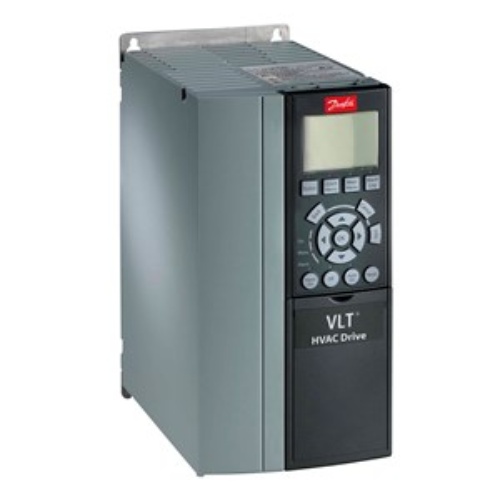
Manufacturing Standards and Testing QC for 7.5 Hp Variable Frequency Drive
At Boray Inverter, every 7.5 HP (5.5 kW) Variable Frequency Drive undergoes a rigorous multi-stage validation protocol engineered specifically for demanding solar pumping and industrial motor control applications. Given that these drives frequently operate in remote agricultural installations and harsh industrial environments—often serving as the critical link between photovoltaic arrays and submersible pump systems—our manufacturing philosophy prioritizes zero-defect reliability through 100% functional testing rather than statistical sampling.
PCB Assembly and Environmental Protection Standards
The foundation of drive reliability begins with IPC-A-610 Class 2-compliant printed circuit board assembly, utilizing automated optical inspection (AOI) and X-ray verification for BGA components. For the 7.5 HP power stage, we implement automated selective conformal coating using acrylic or polyurethane compounds (typically 25-75 μm thickness) that provide moisture and dust ingress protection up to IP20/IP54 ratings. This coating is critical for solar pump inverters exposed to high humidity, condensation, and corrosive agricultural atmospheres, preventing dendritic growth and short-circuit failures in the IGBT driver circuits and switching power supplies.
All PCB assemblies undergo ionic contamination testing (resistivity of solvent extract per IPC-TM-650) to ensure no residual flux or conductive residues remain that could cause leakage currents under high-voltage DC solar input conditions (up to 800VDC in PV-powered configurations).
High-Temperature Aging and Burn-In Protocols
To eliminate infant mortality failures and validate thermal design margins, each 7.5 HP VFD undergoes extended high-temperature burn-in testing at 45°C–50°C ambient for a minimum of 4 hours at 110% rated load. This accelerated life testing simulates the thermal stress of continuous solar pumping operations in equatorial climates, where enclosure temperatures frequently exceed 40°C.
During burn-in, we monitor:
– DC bus capacitor ripple current and ESR stability
– IGBT junction temperatures via thermal imaging (ensuring <125°C under full 13A output at 380V)
– Control board thermal drift for frequency precision maintenance (±0.01% accuracy validation)
Units are subsequently subjected to thermal cycling between -10°C and +60°C to verify solder joint integrity and component tolerance to the diurnal temperature swings common in outdoor solar installations.
100% Full-Load Dynamic Testing
Unlike batch sampling methods, Boray Inverter mandates 100% full-load testing for every 7.5 HP drive before shipment. Each unit is coupled to a dynamometer or regenerative load bank and subjected to:
– 150% overload capacity verification for 60 seconds (simulating pump startup torque requirements)
– Sudden load impact tests (0→100% torque step) to validate current limiting and automatic voltage regulation (AVR) circuits
– Output waveform analysis (THD <3%) under V/F and sensorless vector control modes
– Braking chopper functionality (where applicable) for high-inertia pump applications
For solar pump-specific models, we additionally verify Maximum Power Point Tracking (MPPT) efficiency (>99%) across the 200VDC–800VDC input range, ensuring optimal energy harvest from PV arrays under varying irradiance conditions.
Electrical Safety and EMC Compliance
Safety validation follows IEC 61800-5-1 and IEC 61800-3 standards, with each drive subjected to:
– Hi-pot testing: 2.5kVAC for 60 seconds between mains and earth (leakage current <10mA)
– Insulation resistance testing: >100MΩ at 500VDC
– Surge immunity: 4kV line-to-earth and 2kV line-to-line (IEC 61000-4-5) to withstand lightning-induced transients in remote solar installations
– EMC emissions testing: Compliance with EN 61800-3 Category C2 (industrial) and C3 (heavy industrial) limits for conducted and radiated emissions
Certification and Quality Traceability
Our manufacturing facilities maintain ISO 9001:2015 certification with full material traceability through ERP systems. Each 7.5 HP VFD carries a unique serial number linking to:
– Component batch records (IGBT modules, capacitors, control DSPs)
– Individual test reports (load curves, thermal profiles, safety test results)
– Calibration certificates for current and voltage sensors
CE marking compliance includes adherence to the Low Voltage Directive (2014/35/EU) and Electromagnetic Compatibility Directive (2014/30/EU), with optional UL 508C certification available for North American industrial applications.
This comprehensive QC framework ensures that whether deployed in agricultural irrigation systems, HVAC infrastructure, or process automation, the 7.5 HP VFD delivers the reliability and efficiency critical to minimizing OPEX and maximizing system uptime in the field.
Step-by-Step Engineering Sizing Checklist for 7.5 Hp Variable Frequency Drive
Proper sizing of a 7.5 HP (5.5 kW) Variable Frequency Drive requires rigorous cross-verification between motor characteristics, electrical infrastructure, and environmental operating conditions. For EPC contractors and automation engineers deploying these systems in industrial or solar pumping applications, the following technical checklist ensures compatibility, prevents nuisance tripping, and guarantees the operational longevity expected in 20-year industrial asset lifecycles.
Step 1: Motor Nameplate Verification and Load Characterization
Begin by confirming the motor’s Full Load Amperage (FLA) against the VFD’s rated output capacity. For a 7.5 HP system:
– 380V–480V Applications: Verify motor FLA ≤ 13A continuous; ensure the drive provides 150% overload capacity for 60 seconds (19.5A) and 180% for 3 seconds (23.4A) to handle high-inertia starts or pump cavitation events.
– 208V–240V Applications: Confirm motor FLA ≤ 25A; critical for agricultural installations utilizing lower voltage distribution.
– Torque Requirements: For constant torque loads (positive displacement pumps, compressors), verify the VFD delivers ≥150% rated torque at 1 Hz (Sensorless Vector Control recommended). For variable torque loads (centrifugal pumps, fans), V/F control mode suffices.
Step 2: Input Voltage Topology and Grid/Solar Compatibility
– AC Grid Connection: Confirm supply voltage matches the VFD’s input tolerance (±15%). For 7.5 HP systems, standard configurations include 3-phase 208V, 380V, or 480V ±15%. Verify phase balance; imbalance >3% requires input line reactors.
– Solar Pumping Applications (DC Input): When deploying Boray solar pump inverters, calculate the photovoltaic array’s open-circuit voltage (Voc) at minimum ambient temperature (-10°C) to ensure it never exceeds the VFD’s maximum DC input voltage. Size the MPPT voltage window to capture 70–90% of daily irradiance curves.
Step 3: Solar Array String Sizing Calculations (For PV Systems)
For agricultural or off-grid solar pumping utilizing 7.5 HP drives:
– Power Sizing: Size the PV array at 1.25–1.5x the motor’s nominal power (6.9–8.25 kW) to compensate for morning/afternoon irradiance angles and temperature-related efficiency losses.
– Voltage String Calculation: Configure series strings such that the maximum power point voltage (Vmp) falls within the inverter’s MPPT range under standard test conditions (STC), while Voc at -10°C remains below the VFD’s DC voltage ceiling.
– Current Verification: Ensure total array short-circuit current (Isc) does not exceed the VFD’s DC input current limits when strings are paralleled.
Step 4: Environmental Derating and Enclosure Specifications
– Temperature Derating: Standard operation assumes -10°C to +40°C. For installations in desert agriculture or enclosed industrial panels exceeding 40°C ambient, apply a 5% current derating for every 1°C above threshold. At 50°C ambient, the effective drive capacity reduces to 7.5 HP × 0.5 = 3.75 HP equivalent; upsize accordingly.
– Altitude Compensation: For installations above 1,000m (3,280 ft), derate output current by 1% per 100m to account for reduced air density and cooling efficiency.
– Ingress Protection: Standard IP20 enclosures suit controlled electrical rooms. For outdoor agricultural or wastewater applications, specify IP54 or higher NEMA-rated external enclosures, accounting for additional heat transfer calculations.
Step 5: Control Architecture and Communication Protocols
– Control Mode Selection:
– V/F Control: Acceptable for single-pump, constant-speed-ratio applications with stable grid power.
– Sensorless Vector Control (SVC): Mandatory for multi-pump systems, high-precision flow control, or applications requiring 1:100 speed regulation and ±0.5% speed accuracy.
– PID Integration: For water treatment or pressure-maintaining systems, verify the VFD includes an internal PID controller with feedback loop capability (4–20mA or 0–10V) to eliminate external PLC dependency.
– Network Integration: Confirm RS485/Modbus RTU compatibility for SCADA integration, essential for remote monitoring in unmanned agricultural sites or distributed HVAC systems.
Step 6: Protection Coordination and Power Quality
– Input Side Protection: Size circuit breakers or fuses at 1.5–2.5× the VFD’s rated input current (typically 20–25A for 7.5 HP systems) with Class J or semiconductor fuses to protect against internal rectifier faults.
– Harmonic Mitigation: For installations with multiple VFDs on a single transformer, specify DC chokes or input AC reactors (3% impedance) to limit THDi (Total Harmonic Distortion) to <5% and prevent capacitor bank resonance.
– Output Filtering: For motor cable runs exceeding 50 meters (164 ft), install dv/dt filters or sinusoidal filters to protect motor windings from voltage reflection and bearing currents.
Step 7: Mechanical Integration and Thermal Management
– Mounting Clearances: Verify panel dimensions (e.g., 272mm × 172mm × 182mm for compact 380V class drives) against available enclosure space, maintaining minimum 100mm vertical clearance for heat dissipation.
– Cooling Calculations: Calculate total heat rejection (approximately 200–250W for a 7.5 HP drive at full load) and ensure enclosure ventilation or active cooling maintains internal ambient below 40°C.
– Cable Sizing: Size output cables at 125% of motor FLA, accounting for voltage drop (<3%) over the run length. Use shielded cables for VFD outputs to reduce EMI.
Step 8: Commissioning Verification Protocol
– Static Test: Prior to energization, verify diode integrity across R/S/T (input) and U/V/W (output) terminals using a multimeter in diode mode to detect pre-existing rectifier or IGBT faults.
– No-Load Test: Run the VFD at 25%, 50%, 75%, and 100% speed setpoints without coupled load to verify output voltage symmetry and current draw balance.
– Load Test: Under operational load, confirm the VFD maintains output current within ±2% of calculated values and that automatic energy-saving functions (V/F optimization) activate correctly under partial loads.
Critical Sourcing Note for Distributors: When specifying 7.5 HP VFDs for international projects, verify the unit’s certification portfolio (CE, UL, IEC 61800-3) matches the destination country’s grid code requirements. For solar pumping tenders, ensure the VFD supports dual AC/DC input capability or dedicated PV mode with maximum power point tracking (MPPT) algorithms specifically optimized for submersible pump motor characteristics.
Wholesale Cost and Energy ROI Analysis for 7.5 Hp Variable Frequency Drive
When evaluating 7.5 HP (5.5 kW) variable frequency drives for industrial or agricultural deployment, procurement decisions extend far beyond unit acquisition costs. For EPC contractors sizing solar pumping stations or automation distributors managing inventory risk, the economic analysis must encompass wholesale pricing tiers, energy recovery timelines, and total cost of ownership (TCO) implications across the equipment lifecycle.
B2B Wholesale Pricing Architecture and Volume Economics
The 7.5 HP VFD segment represents a high-volume sweet spot in industrial automation, creating distinct pricing stratifications based on procurement volume and technical specifications. Standard 380V/480V three-phase units with IP20 enclosures and V/F or sensorless vector control typically wholesale between $280–$450 per unit for quantities of 10–49 pieces, dropping to $220–$350 at 100+ unit volumes. Solar pump inverter variants—incorporating MPPT algorithms and DC input capabilities for direct PV coupling—command a 15–25% premium over standard AC drives due to specialized firmware and enhanced input voltage tolerances (up to 800VDC).
Retail markup structures vary significantly by channel:
– Industrial distributors typically apply 35–50% margins, positioning shelf prices at $450–$700
– EPC contractors purchasing direct from manufacturers like Boray Inverter for project-specific deployments often negotiate turnkey pricing at 20–30% below retail, inclusive of application engineering support
– OEM panel builders securing annual contracts may achieve 60-day payment terms with pricing locked at 12-month intervals, critical for margin protection in volatile semiconductor markets
For agricultural project managers evaluating solar irrigation retrofits, the delta between wholesale AC VFDs and dedicated solar pump inverters (5.5 kW rated) becomes economically justified when factoring eliminated AC infrastructure costs—bypassing inverters, transformers, and grid connection fees that often exceed $2,000 per rural installation.
Energy ROI Quantification and Payback Modeling
The financial justification for 7.5 HP VFD deployment hinges on load profile analysis and local energy tariffs. In centrifugal pump applications—the primary use case for this power class—affinity laws dictate that reducing motor speed by 20% yields 49% energy savings, creating compelling ROI in variable-flow systems.
Standard Industrial Scenario (Grid-Powered):
– Baseline consumption: 5.5 kW motor running 2,000 hours annually at 85% load factor = 9,350 kWh/year
– With VFD optimization: 30% average reduction in energy draw (2,805 kWh saved annually)
– At $0.13/kWh industrial rate: $364 annual savings
– Payback period: 8–14 months for wholesale-acquired units ($400–$500 installed cost)
Solar Pumping Scenario (Diesel Displacement):
For agricultural EPCs replacing 7.5 HP diesel pumps with solar-electric systems, the economics shift dramatically:
– Diesel baseline: 3.5–4.5 liters/hour consumption at $1.15/liter = $4.03–$5.18/hour operating cost
– Solar VFD system: Levelized energy cost of $0.03/kWh equivalent
– Annual operating hours (irrigation): 1,200 hours
– Net savings: $4,200–$5,800 annually versus diesel
– System payback: 18–24 months inclusive of PV array costs, with the VFD component (representing 8–12% of system CAPEX) delivering disproportionate value through MPPT optimization and soft-start functionality that extends pump mechanical life by 40–60%.
Warranty Cost Allocation and Risk Management
Wholesale procurement strategies must account for warranty exposure across global distribution networks. Standard 7.5 HP VFDs typically carry 18-month warranties for general industrial applications, while solar pump inverter variants often extend to 24–36 months given the harsh environmental exposure (IP65 requirements, 50°C+ ambient temperatures).
For automation distributors, warranty reserve calculations should factor:
– Failure rates: Quality-tier Chinese manufacturers (Boray Inverter classification) demonstrate <2% annual failure rates in controlled environments, escalating to 4–6% in agricultural solar applications without proper derating
– Replacement logistics: Sea freight warranty replacements incur 45–60 day lead times; distributors should maintain 5–7% buffer stock for critical accounts
– Extended coverage: Third-party warranty extensions to 5 years typically cost 8–12% of unit wholesale price—economically justified for remote solar pumping installations where service calls exceed $500 per dispatch
Total Cost of Ownership (TCO) Considerations
Beyond sticker price, EPC contractors must model installation and commissioning costs. Units featuring integrated DC reactors, EMC filters, and RS485 Modbus connectivity reduce external component costs by $80–$150 per installation while simplifying commissioning—a critical factor when technician time bills at $75–$120/hour.
For high-altitude deployments (>1,000m) common in solar pumping projects, derating requirements necessitate upsizing to 10 HP drives to maintain 7.5 HP output, increasing wholesale costs by 35% but preventing thermal failures that void warranty coverage. This “hidden cost” of altitude derating often surprises first-time solar EPCs but is essential for 25-year project IRR calculations.
Strategic Procurement Recommendations
For Industrial Engineers: Specify drives with automatic energy optimization (AEO) algorithms and onboard PLC functionality, accepting 10–15% wholesale price premiums to eliminate external automation hardware.
For Agricultural Project Managers: Negotiate project-based volume discounts combining 7.5 HP solar pump inverters with 3 HP and 5 HP variants for multi-zone irrigation, achieving blended pricing tiers while ensuring firmware compatibility across the farm automation network.
For EPC Contractors: Structure procurement with letter-of-credit terms for 40-foot container quantities, securing landed costs 18–22% below spot pricing while hedging against IGBT module price volatility.
For Distributors: Focus inventory on 480V three-phase units with dual-rating capability (7.5 HP/10 HP) to maximize application flexibility across HVAC and pumping verticals, minimizing SKU proliferation while capturing premium solar pump inverter margins through value-added configuration services.
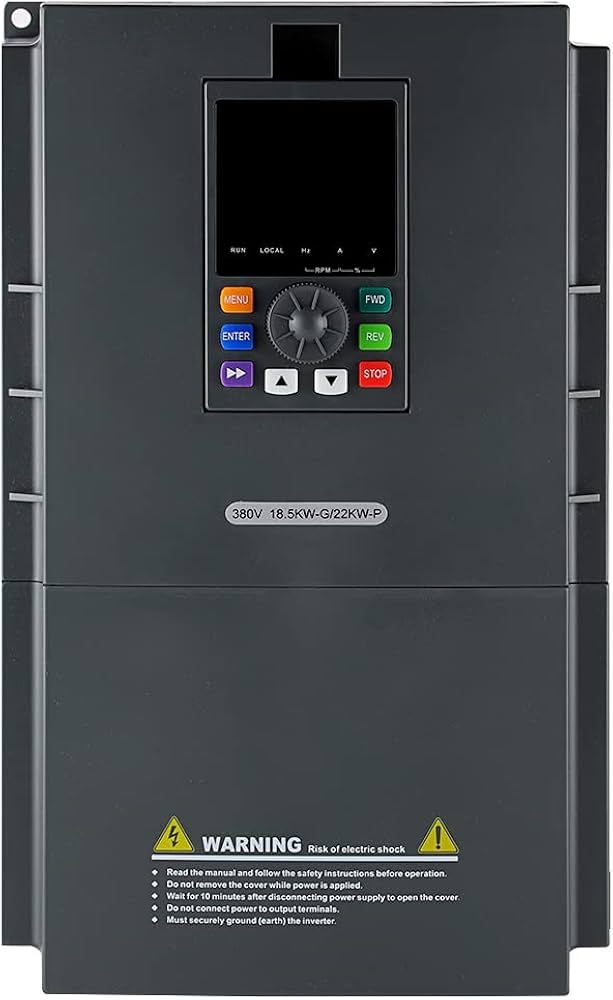
Alternatives Comparison: Is 7.5 Hp Variable Frequency Drive the Best Choice?
When specifying motor control for 5.5 kW (7.5 HP) loads—a common requirement for agricultural irrigation, HVAC secondary pumps, and light industrial conveyors—engineers must evaluate the total system architecture, not merely the drive itself. While a 7.5 HP Variable Frequency Drive offers superior speed regulation and energy optimization, alternatives such as soft starters, direct-on-line (DOL) configurations, or solar-dedicated inverters may present superior value depending on operational duty cycles, grid availability, and motor technology. Below is a technical analysis of these alternatives to determine when a 7.5 HP VFD is the definitive choice versus when simplified solutions suffice.
Motor Starting Methodologies: VFD vs. Soft Starter vs. DOL
For 7.5 HP (13A at 380V–480V, 25A at 220V–240V) applications, the starting methodology fundamentally dictates mechanical stress, energy efficiency, and system longevity.
Direct Online (DOL) Starting
The simplest method applies full voltage immediately, resulting in inrush currents of 600–800% of Full Load Amperage (FLA). While cost-effective for infrequently started, constant-speed pumps or fans, DOL starting imposes severe mechanical stress on couplings and bearings and offers no energy optimization during partial load operation.
Soft Starters (Reduced Voltage Soft Starters – RVSS)
Soft starters utilize thyristor-based voltage ramping to limit inrush current to 200–300% of FLA, reducing mechanical shock during startup. However, they cannot vary operating speed once the motor reaches full speed. For 7.5 HP applications with high inertia loads (e.g., large flywheels or centrifugal fans) that run at fixed speed but require frequent starts, soft starters offer a middle-ground solution at roughly 40–60% of a VFD’s cost.
Variable Frequency Drives (VFD)
VFDs provide full-range speed control (0–1000Hz in advanced models), maintaining constant V/Hz ratios or vector control profiles. Beyond soft-start capabilities, they enable energy savings of 15–40% in variable torque applications (pumps/fans) via affinity laws. For 7.5 HP systems requiring flow modulation—such as precision irrigation or HVAC pressure maintenance—the VFD is the only alternative that eliminates throttling losses and maintains high power factor across the operating range.
| Feature | DOL Starter | Soft Starter | 7.5 HP VFD |
|---|---|---|---|
| Starting Current | 600–800% FLA | 200–300% FLA | 100–150% FLA (configurable) |
| Speed Control | None (Fixed) | None (Fixed) | 0–100% continuous |
| Energy Efficiency | Low (no optimization) | Low (no optimization) | High (V/Hz optimization, regenerative options) |
| Torque Control | Line start torque only | Reduced start torque | Full torque control (150% at 1Hz with vector control) |
| Initial Cost | $ (Low) | $$ (Medium) | $$$ (Higher) |
| Best Application | Constant speed, infrequent start | High inertia, fixed speed | Variable flow, precise process control |
Power Source Architecture: Grid-Tied vs. Solar Pump Inverters
For remote agricultural or off-grid industrial sites, the 7.5 HP motor’s power source becomes a critical decision point. Boray Inverter specializes in solar pump solutions that fundamentally alter the traditional VFD topology.
Grid-Tied Standard VFD
Traditional 3-phase VFDs (208V/380V/480V ±15%) require stable AC grid input. They offer consistent performance and are ideal for 24/7 manufacturing processes or municipal water systems with reliable grid infrastructure. However, they incur ongoing energy costs and lack functionality for DC power sources.
Solar Pump Inverters (DC-to-AC VFD with MPPT)
Solar-dedicated 7.5 HP inverters integrate Maximum Power Point Tracking (MPPT) directly into the drive architecture, accepting high-voltage DC string input (typically 200V–800VDC) without requiring separate inverters or batteries. For irrigation systems operating during daylight hours, this eliminates grid dependency and operating costs. The trade-off is weather dependency; however, modern solar VFDs include AC backup inputs or hybrid functionality for critical applications.
Hybrid Configurations
Advanced 7.5 HP drives now offer AC/DC dual-input capabilities, automatically switching between solar DC (priority) and grid AC (backup). This maximizes renewable energy utilization while ensuring 100% uptime for crop irrigation or process cooling.
| Parameter | Grid-Tied VFD | Solar Pump Inverter | Hybrid System |
|---|---|---|---|
| Input Power | 3-Phase AC (208V–480V) | High-Voltage DC (Solar Array) | AC/DC Auto-switching |
| Energy Cost | Ongoing utility costs | Zero (fuel-free) | Reduced (solar priority) |
| Installation Complexity | Standard electrical | Requires PV array sizing | Moderate (dual input) |
| Operational Reliability | Grid-dependent | Weather-dependent | Highest (redundant) |
| Typical ROI | 2–3 years (energy savings) | 1.5–3 years (vs. diesel) | 2–4 years |
| Optimal Use Case | Industrial process control | Remote agriculture/water pumping | Critical irrigation with grid backup |
Motor Technology Pairing: Induction Motors (IM) vs. Permanent Magnet Synchronous Motors (PMSM)
The 7.5 HP VFD’s performance characteristics change significantly based on motor technology selection.
Induction Motor (IM) + VFD
Standard squirrel-cage induction motors (IE2/IE3 efficiency) paired with VFDs using V/Hz or Sensorless Vector Control (SVC) represent the most cost-effective solution. They tolerate wide voltage fluctuations (±15%) and operate reliably in dusty agricultural environments. However, at partial loads (common in irrigation), efficiency drops to 60–70%, and power factor correction may be required.
Permanent Magnet Synchronous Motor (PMSM) + VFD
PMSMs (IE4/IE5 efficiency) require VFDs with Field-Oriented Control (FOC) or Flux Vector Control (FVC) but deliver 10–20% higher efficiency across the speed range, particularly at low speeds (20–50% rated speed). For 7.5 HP solar pumping systems where every watt of PV generation counts, PMSM-VFD combinations maximize water output per solar watt-hour. The limitation is higher motor cost and potential demagnetization risks in high-temperature environments (>60°C ambient) without proper cooling.
| Specification | Induction Motor + VFD | PMSM + VFD |
|---|---|---|
| Efficiency Class | IE2/IE3 (Premium) | IE4/IE5 (Super Premium) |
| Control Mode Required | V/Hz or SVC | FVC/FOC (Mandatory) |
| Partial Load Efficiency | 60–75% | 85–92% |
| Power Factor | 0.75–0.85 (lagging) | >0.95 (unity) |
| Cost Premium | Baseline | +30–50% motor cost |
| Temperature Resilience | High (robust) | Moderate (magnet sensitivity) |
| Best Fit | General industrial, budget projects | Solar pumping, high-duty cycle |
Strategic Selection Guidelines
Choose the 7.5 HP VFD when:
– The application requires flow/pressure modulation (variable torque loads)
– Energy recovery justifies the capital expenditure (typically >2,000 annual operating hours)
– Soft starting is required to protect mechanical equipment from water hammer or belt stress
– Integration with PLC/SCADA systems for Industry 4.0 automation is planned
Consider Alternatives when:
– Soft Starter: The motor runs at fixed speed but starts frequently (>6 times/hour) and grid capacity cannot handle DOL inrush.
– DOL: Cost is the primary constraint for rarely used standby pumps or conveyors with no speed variation needs.
– Solar Direct: For remote 7.5 HP irrigation where grid extension costs exceed $15,000–$20,000, a solar pump inverter with PMSM motor offers the lowest lifecycle cost despite higher upfront investment.
For EPC contractors and automation distributors, the 7.5 HP VFD remains the most versatile platform, particularly when specifying Boray’s solar-compatible series that bridge grid-tied reliability with off-grid sustainability. The critical decision lies not in whether to use a VFD, but in selecting the appropriate control algorithm (V/Hz for IM, FOC for PMSM) and power input topology (AC grid vs. DC solar) to match the specific duty cycle and environmental constraints of the 5.5 kW load.
Core Technical Specifications and Control Terms for 7.5 Hp Variable Frequency Drive
When specifying a 7.5 HP (5.5 kW) variable frequency drive for industrial or solar pumping applications, engineers and procurement specialists must evaluate both the electromechanical control architectures and the commercial frameworks governing international logistics. This power rating represents a critical node in automation infrastructure—sufficient for heavy-duty irrigation pumps, HVAC blowers, and conveyor systems—yet requires precise matching of control algorithms to load characteristics and environmental derating curves.
Electrical Ratings and Thermal Characteristics
A 7.5 HP VFD typically accommodates three-phase input configurations across 208V, 380V, or 480V nominal systems (±15% tolerance), with corresponding rated currents of approximately 25A at 220V–240V or 13A at 380V–480V. Output frequency ranges from 0 Hz to 400 Hz (or extended to 1000 Hz for specialized high-speed spindles), utilizing PWM (Pulse Width Modulation) carrier frequencies adjustable between 2 kHz and 16 kHz to balance acoustic noise against switching losses.
Critical Derating Parameters:
– Ambient Temperature: Standard operation requires –10°C to +40°C; above 40°C, continuous output current must be derated by 5% for each additional 1°C to protect IGBT thermal junctions.
– Altitude: For installations above 1,000 meters, derate current by 1% per 100m to compensate for reduced air density and cooling efficiency.
– Overload Capacity: Heavy-duty VFDs must sustain 150% of rated current for 60 seconds and 180% for 3 seconds to handle pump inrush or compressor starting torques without tripping.
Motor Control Strategies: From V/F to Vector Control
The selection of control mode determines torque response and speed regulation accuracy:
| Control Mode | Speed Range | Starting Torque | Best Application |
|---|---|---|---|
| V/F Control | 1:40 | 150% at 3 Hz | Fans, pumps with quadratic torque curves |
| SVC (Sensorless Vector Control) | 1:100 | 150% at 1 Hz | Conveyors, mixers requiring mid-range dynamics |
| FVC (Field-Oriented Control) | 1:1000 | 200% at 0 Hz | Positioning systems, high-dynamic lifts |
V/F Control maintains a constant Volts-per-Hertz ratio, suitable for multi-motor parallel operation but offering limited low-speed torque. Sensorless Vector Control (SVC) eliminates encoder feedback while achieving ±0.5% speed accuracy through motor parameter auto-tuning, critical for agricultural irrigation where pressure fluctuations must be minimized. Advanced drives incorporate Automatic Torque Boost (0.1%–30.0% manual adjustment or automatic optimization) to compensate for voltage drop across long motor leads in remote solar installations.
Solar Pumping Integration: MPPT and DC Bus Architecture
For photovoltaic-powered systems, the VFD must function as a solar pump inverter with specialized DC input stages:
- MPPT (Maximum Power Point Tracking): Algorithms track the PV array’s optimal voltage-current curve in real-time, typically maintaining >99% tracking efficiency despite irradiance fluctuations from cloud transients. The DC input voltage range (e.g., 200V–800V) must accommodate open-circuit voltages of 60-cell or 72-cell PV strings.
- Dual Supply Capability: Hybrid models accept both AC grid input and DC solar input, automatically switching to grid power during low irradiance without manual intervention.
- Sleep/Wake Functionality: When water demand is satisfied (detected via pressure transducers or flow sensors), the drive enters sleep mode, restarting automatically when system pressure drops below setpoints—essential for 24/7 autonomous agricultural operations.
Process Control: PID and Closed-Loop Automation
Modern 7.5 HP drives integrate interior PID controllers, eliminating external PLC modules for pressure or flow regulation. By configuring analog inputs (4–20 mA or 0–10 V) from pressure transmitters, the drive modulates motor speed to maintain constant discharge pressure in booster pump stations. Automatic Energy Saving modes optimize the V/F curve based on real-time load detection, reducing consumption by 20–40% in variable-torque applications compared to across-the-line operation.
Communication Protocols and I/O Configuration
Standard interfaces include RS485 serial communication supporting Modbus RTU protocols, enabling SCADA integration for remote monitoring of run status, fault codes, and energy consumption. Digital inputs accept NPN/PNP signals for forward/reverse commands and multi-speed selection, while relay outputs provide fault indication to building management systems. For harsh agricultural environments, optional IP54 or IP65 enclosures protect against dust ingress and direct water jets, contrasting with standard IP20 (ventilated) ratings suitable for electrical rooms.
International Commercial Terms: FOB vs. CIF
For EPC contractors and distributors managing cross-border procurement, understanding Incoterms 2020 definitions prevents logistical disputes:
-
FOB (Free On Board): The seller delivers goods cleared for export onto the vessel designated by the buyer at the named port of shipment. Risk transfers when goods pass the ship’s rail; the buyer assumes ocean freight, insurance, and import clearance costs. This term favors buyers with established freight forwarding networks seeking to optimize shipping routes from Chinese manufacturing hubs like Shenzhen or Ningbo.
-
CIF (Cost, Insurance, and Freight): The seller contracts for carriage and minimum insurance coverage to the named destination port. Risk still transfers at the port of shipment (identical to FOB), but the seller bears freight and insurance costs. CIF suits agricultural project managers requiring turnkey logistics solutions where local import expertise is limited, though buyers should note that insurance coverage under CIF is typically minimal (Institute Cargo Clauses C) and may require supplemental policies for high-value automation equipment.
Logistical Considerations: A 7.5 HP VFD in standard IP20 configuration typically ships in corrugated packaging with dimensions approximately 272 mm × 172 mm × 182 mm and gross weight under 6 kg, allowing palletized consolidation (40–50 units per standard pallet) for efficient container utilization under either FOB or CIF arrangements. For solar pump inverter variants with external DC chokes or IP65 enclosures, verify dimensional weight calculations, as protective casings may increase shipping volumes disproportionately to mass.
When specifying Boray Inverter’s 7.5 HP series, ensure procurement documentation explicitly states required control modes (SVC for pump duty), environmental ratings (IP54 for outdoor agricultural deployment), and preferred Incoterms to align technical capabilities with supply chain execution.
Future Trends in the 7.5 Hp Variable Frequency Drive Sector
The 7.5 HP (5.5 kW) variable frequency drive represents a critical power node where legacy industrial infrastructure intersects with digital transformation. As the preferred capacity for mid-scale agricultural irrigation, HVAC secondary systems, and light industrial process automation, this drive class is undergoing rapid technological evolution. Stakeholders across the value chain—from EPC contractors designing solar pumping stations to automation engineers optimizing manufacturing lines—must anticipate three convergent trajectories: autonomous motor control intelligence, seamless renewable energy hybridization, and pervasive IoT-enabled operational transparency.
Intelligent Automation and Edge Analytics
The next generation of 7.5 HP VFDs is transcending traditional V/F control methodologies in favor of sensorless vector control algorithms enhanced by machine learning inference at the edge. Rather than relying solely on pre-programmed torque curves, advanced drives now utilize real-time load profiling to predict mechanical resonance points and adjust switching frequencies dynamically. This is particularly critical for agricultural applications where pump affinity laws meet variable well depths; modern drives automatically optimize IGBT switching patterns to minimize THDi (Total Harmonic Distortion) while maintaining precise flow rates.
Integration with Industry 4.0 architectures demands enhanced connectivity protocols. While RS485 Modbus remains ubiquitous (as evidenced in current-generation specifications), the migration toward EtherCAT and PROFINET-enabled 7.5 HP drives allows for sub-millisecond synchronization with upstream PLCs. For EPC contractors, this means reduced commissioning time—parameters for torque boost, acceleration ramps, and PID setpoints can be pushed centrally across distributed pumping stations without manual field configuration.
Solar-Electrification and Hybrid DC/AC Architectures
Perhaps the most significant disruption in the 7.5 HP sector is the dissolution of boundaries between grid-tied VFDs and solar pump inverters. Traditionally distinct categories, these technologies are converging into intelligent hybrid drives capable of dual-source operation. Modern 7.5 HP units now feature integrated Maximum Power Point Tracking (MPPT) controllers with wide DC input voltage ranges (typically 200V–800V), allowing direct PV array connection without external inverters.
For agricultural project managers, this architectural shift enables true energy autonomy. Advanced drives can seamlessly transition between solar DC input and three-phase AC grid power (208V/380V/480V) without mechanical switching, utilizing the DC bus as a common energy reservoir. During peak irradiance, the drive powers the motor entirely from PV arrays; during cloud transients or night operation, it automatically supplements from grid or battery storage. This “solar-first” logic, combined with automatic voltage regulation (AVR) capabilities, ensures that irrigation schedules remain uninterrupted regardless of irradiance variability.
Furthermore, regenerative energy recovery—once reserved for high-power industrial drives—is becoming standard in the 7.5 HP class. When controlling high-inertia loads such as borehole pumps or ventilation fans, these drives can return excess kinetic energy to the DC bus or grid, significantly reducing overall energy consumption in cyclic applications.
IoT-Enabled Predictive Maintenance and Digital Twins
The commoditization of cellular and LoRaWAN connectivity is transforming 7.5 HP VFDs from isolated power conversion devices into networked sensor nodes. Embedded IoT modules now transmit not only operational status (frequency, current, temperature) but also predictive health metrics derived from vibration harmonics and bearing current analysis. For maintenance teams managing distributed assets across multiple agricultural sites or industrial facilities, this capability shifts strategy from reactive repair to condition-based intervention.
Cloud-based parameter management platforms allow automation distributors to offer value-added services such as remote firmware updates and application-specific macro configurations. A drive controlling a centrifugal pump in a wastewater treatment facility can receive optimized PID parameters tuned for viscosity changes during seasonal temperature shifts, pushed over-the-air without service truck dispatches.
Cybersecurity considerations are equally paramount. As these drives integrate with corporate OT networks, next-generation 7.5 HP VFDs incorporate encrypted communication channels, secure boot mechanisms, and role-based access controls to prevent unauthorized parameter manipulation—a critical concern for critical infrastructure operators.
Material and Thermal Management Innovations
Advancements in wide-bandgap semiconductor materials (SiC and GaN) are beginning to penetrate the 7.5 HP market, promising higher switching frequencies with reduced thermal losses. This enables more compact chassis designs—critical for retrofit installations in crowded MCCs (Motor Control Centers)—while improving efficiency margins beyond traditional IGBT-based systems. Combined with intelligent thermal management algorithms that derate operation based on real-time ambient temperature sensing (rather than static altitude/temperature tables), these drives offer enhanced reliability in harsh environments ranging from desert solar farms to humid tropical processing facilities.
Strategic Implications for B2B Procurement
For industrial engineers and contractors specifying 7.5 HP systems, the procurement calculus is shifting from capital expenditure (CapEx) optimization to total cost of ownership (TCO) minimization. Drives offering native solar compatibility, edge analytics, and cloud connectivity may command modest premiums upfront but deliver substantial operational savings through reduced energy costs, extended bearing life via soft-start algorithms, and minimized unplanned downtime. As global efficiency mandates tighten and Industry 4.0 adoption accelerates, the 7.5 HP VFD is evolving from a simple motor controller into an intelligent energy management hub—positioning early adopters for significant competitive advantages in operational efficiency and sustainability metrics.
Top 3 7.5 Hp Variable Frequency Drive Manufacturers & Suppliers List
Variable Frequency Drives Manufacturers – VFDs.org
Website: vfds.org
Content analysis of vfds.org reveals exclusively Variable Frequency Drive (VFD) specifications from Chinese manufacturer Shenzhen Gozuk, with no solar inverters or solar pump inverters present. Product range spans 2.2kW (3HP) to 75HP (55kW) with input voltages of 3-phase 380V-440V AC (±15% tolerance), 50/60Hz, plus single-phase 220V/480V SWER input options. Output specifications: 3-phase 0-rated i…
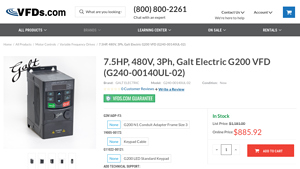
7.5HP, 480V, 3Ph, Galt Electric G200 VFD (G240-00140UL-02)
Website: vfds.com
Product: Galt Electric G200 Series VFD (Model: G240-00140UL-02). Specifications: 7.5HP, 480V, 3-Phase input, micro drive designed for smaller industrial applications with 120% overload capacity (deratable to 150% or 200% constant torque). Available in multiple input configurations: 120V/single phase, 240V/single phase, 240V/3-phase, and 480V/3-phase, ranging up to 15HP. Technology: Vectorized V/F …
AC Variable Frequency Drives (VFD) | AutomationDirect
Website: automationdirect.com
AutomationDirect offers AC Variable Frequency Drives (VFD) for speed control of 3-phase AC motors in conveyors, fans, pumps, and shop tools, with power ratings up to 300hp. The portfolio includes four main categories: Micro VFDs (WEG CFW100 with built-in HMI/PLC and SVC/VF/VVW control; DURApulse GS10 with SVC/VF modes; IronHorse ACM for single-phase input with sensorless vector/V/Hz control); Gene…
B2B Engineering FAQs About 7.5 Hp Variable Frequency Drive
-
What input voltage configurations are available for 7.5 HP (5.5 kW) VFDs, and how do current ratings vary across three-phase supply voltages?
A 7.5 HP VFD typically supports three-phase input voltages of 208V, 380V, and 480V AC (±15% tolerance). Current ratings differ significantly by voltage: approximately 25A at 220V–240V ranges versus 13A at 380V–480V ranges. When specifying for international EPC projects, verify that the drive’s input voltage range accommodates local grid fluctuations (e.g., 380V/50Hz in EU/Asia or 480V/60Hz in North America) without requiring additional transformers. Boray Inverter’s YC-5000 series, for example, provides auto-voltage regulation (AVR) to maintain constant output despite input variations. -
How do overload capacity specifications (150% for 1 minute, 180% for 3 seconds) influence motor protection coordination in high-inertia pump applications?
These overload ratings define the drive’s ability to deliver starting torque bursts required for submersible pumps or positive displacement pumps without tripping. For a 7.5 HP motor with a Full Load Ampere (FLA) of approximately 11A (at 460V), the VFD can sustain 16.5A for 60 seconds and 19.8A for 3 seconds. Engineers should configure the electronic motor overload protection (Class 10/20) to coordinate with these curves, ensuring the VFD trips before motor insulation damage occurs while allowing sufficient time for pump acceleration in high-static-head irrigation systems. -
When deploying 7.5 HP systems for solar-powered irrigation, what distinguishes a dedicated solar pump inverter from a standard VFD with DC input capabilities?
Dedicated solar pump inverters (like Boray’s solar VFD series) integrate Maximum Power Point Tracking (MPPT) algorithms specifically optimized for photovoltaic arrays, maximizing energy harvest during variable irradiance. Unlike standard industrial VFDs retrofitted with DC bus connections, solar-specific 7.5 HP drives feature wide DC input voltage ranges (typically 200V–800V DC) and automatic switching between AC grid backup and DC solar modes. They also eliminate the need for separate solar inverters, reducing system complexity and conversion losses by 15–20% in off-grid agricultural applications. -
What derating calculations are required when installing a 7.5 HP VFD above 1000m altitude or in ambient temperatures exceeding 40°C?
Standard 7.5 HP VFDs (IP20 enclosure) require 5% current derating for every 1°C above 40°C ambient temperature. At 50°C, the drive’s continuous output current drops to approximately 11.7A (from 13A), effectively reducing usable horsepower to ~6.75 HP. For altitudes above 1000m, derate by 1% per 100m due to reduced air density and cooling efficiency. In high-temperature desert climates or high-altitude Andean/African installations, specify drives with external cooling fans or install within climate-controlled NEMA 3R/12 enclosures to maintain rated 5.5 kW output. -
For constant torque applications (positive displacement pumps) versus variable torque (centrifugal pumps), which control mode should engineers select: V/F or Sensorless Vector Control (SVC)?
For centrifugal pumps (variable torque), standard V/F control with automatic torque boost (0.1%–30%) is sufficient and energy-efficient. However, for positive displacement pumps, screw pumps, or conveyor systems requiring high starting torque, select Sensorless Vector Control (SVC). SVC provides 150% rated torque at 1 Hz with ±0.5% speed accuracy, preventing pump cavitation and ensuring precise flow control in process automation. The YC-5000 series supports both modes, allowing firmware switching based on application requirements. -
How does IP20 ingress protection rating impact enclosure specifications for 7.5 HP VFDs in wastewater treatment or outdoor agricultural environments?
IP20 rating offers protection against solid objects >12.5mm but no moisture protection. For outdoor solar pumping or wastewater facilities with 5%–95% humidity and potential condensation, engineers must specify NEMA 4X (IP65) external enclosures or cabinet installations with sealed cable glands and desiccant breathers. Additionally, ensure the operating environment remains within -10°C to +40°C; for storage in extreme climates, maintain -20°C to +60°C conditions without condensation to preserve capacitor longevity. -
What harmonic mitigation strategies are necessary when installing multiple 7.5 HP VFDs on a single distribution transformer in industrial facilities?
Standard 6-pulse VFDs generate 5th and 7th harmonics that can exceed IEEE 519 limits when multiple drives operate simultaneously. For installations with >3 drives on a shared 480V bus, implement 3% AC line reactors or DC link chokes to reduce Total Harmonic Distortion (THD) to <5%. Alternatively, specify drives with active front ends (AFE) or 12-pulse rectifiers for sensitive agricultural processing facilities where power quality affects precision equipment. RS485 communication daisy-chaining should utilize shielded twisted-pair cables to prevent EMI interference from switching frequencies. -
How does the RS485 Modbus RTU interface facilitate SCADA integration for remote monitoring of 7.5 HP pump stations?
The RS485 port enables multi-drop networking of up to 32 VFDs on a single bus (extendable to 128 with repeaters) over distances up to 1200m. Engineers can remotely monitor critical parameters including output current (0.1A resolution), DC bus voltage, and fault codes (over-current, over-voltage, phase loss) while adjusting frequency setpoints (0.01 Hz resolution) via PLC or SCADA. For solar pumping applications, this allows centralized monitoring of array voltage, pump speed, and flow rates, enabling predictive maintenance algorithms that reduce unplanned downtime in remote agricultural installations.
Disclaimer
⚠️ Important Disclaimer
The information provided in this guide is for educational purposes. Industrial applications and electrical engineering projects carry inherent risks. B2B buyers and contractors must conduct thorough technical due diligence and verify regional compliance before installation or procurement.
Conclusion: Partnering with Boray Inverter for 7.5 Hp Variable Frequency Drive
Selecting the optimal 7.5 HP VFD transcends basic specifications—it requires partnering with a manufacturer that understands the nuanced demands of modern motor control, from precision torque management in industrial automation to reliable performance in off-grid solar pumping systems. As industries worldwide prioritize energy efficiency and intelligent automation, the technical sophistication of your drive supplier becomes a critical determinant of project success, system longevity, and long-term operational ROI.
Shenzhen Boray Technology Co., Ltd. stands at the forefront of this evolution as a specialized innovator in Solar Pumping and Motor Control Solutions. With an engineering-centric culture where R&D talent comprises 50% of the workforce, Boray Inverter has mastered advanced PMSM (Permanent Magnet Synchronous Motor) and IM (Induction Motor) vector control technologies that deliver exceptional dynamic response, precise speed regulation, and superior energy efficiency across diverse load profiles. Their manufacturing excellence is evidenced by dual modern production lines and rigorous 100% full-load testing protocols, ensuring every 7.5 HP unit withstands real-world operational stresses before deployment.
Trusted by EPC contractors, agricultural project managers, and industrial automation distributors across continents, Boray’s solutions excel in demanding applications—from large-scale agricultural irrigation systems requiring precise flow control to manufacturing lines demanding high-starting torque and speed accuracy. Whether you require standard grid-tied industrial drives or specialized solar pump inverters optimized for remote, off-grid installations, Boray’s technical team provides customized VFD solutions engineered to your exact electrical and environmental specifications.
Elevate your next project with a partner that combines deep R&D expertise with uncompromising manufacturing standards. Contact Boray Inverter today at borayinverter.com to discuss your 7.5 HP VFD requirements and request competitive wholesale quotes tailored to your volume and application needs.