Selecting the wrong VFD specification doesn’t just waste capital—it quietly drains your operational budget through energy inefficiency and premature drive failure. For facility managers running irrigation systems or engineers specifying conveyor drives, the distinction between Heavy Duty and Normal Duty ratings isn’t merely technical jargon; it’s the difference between a system that thrives under shock loads and one that falters when demand spikes.
Understanding these duty ratings ensures you match drive capability to actual motor stress, preventing both costly over-specification and dangerous under-sizing. Whether you’re optimizing pump stations for agricultural efficiency or ensuring continuous production line reliability, choosing correctly protects your margins while extending equipment lifespan. This guide breaks down exactly when to invest in Heavy Duty torque reserves versus when Normal Duty variable torque control delivers optimal ROI, helping you build systems that perform reliably without paying for capacity you don’t need.
Heavy Duty vs. Normal Duty VFD: The Engineering Reality Behind Drive Ratings
The Direct Technical Distinction
Normal Duty (ND) and Heavy Duty (HD) are not distinct hardware categories but rather thermal derating classifications of the same Variable Frequency Drive (VFD) platform. An HD rating represents the identical drive hardware operating under more restrictive current and thermal constraints.

Normal Duty corresponds to Variable Torque (VT) applications—centrifugal pumps, fans, and blowers—where load demands decrease exponentially with speed. These drives are rated for 110% overload for 60 seconds and prioritize continuous current capacity over starting torque.
Heavy Duty corresponds to Constant Torque (CT) applications—conveyors, crushers, mixers, and hoists—where full torque is required from zero speed through base speed. These configurations are rated for 150% overload for 60 seconds (and often 200% for 3 seconds), sacrificing continuous horsepower rating to gain higher transient current capacity for breakaway torque.
Practically, this creates an inverse relationship: a 30 HP ND drive possesses the identical continuous current rating as a 25 HP HD drive. The “heavy duty” designation simply indicates the drive can sustain higher percentage overloads for starting high-inertia loads, but must be derated to a lower continuous horsepower to maintain thermal margins. Selecting HD for a VT application constitutes unnecessary oversizing and capital waste, while selecting ND for a CT application guarantees nuisance tripping or thermal failure.

Technical Factors Affecting Cost and Selection
Overload Capacity and Thermal Design
The primary cost driver distinguishing ND from HD applications is the thermal management requirement. HD-rated operation requires:
– Enhanced IGBT modules with higher surge current ratings
– Larger heat sinks or forced-air cooling systems to dissipate heat from sustained high-current operation
– Heavier bus bar and capacitor banks sized for 150% current spikes
– Class H insulation systems (125°C rise) versus Class B (80°C rise) in associated motors
Current Rating vs. Nameplate Horsepower
The most critical specification is the drive’s Full Load Amps (FLA) rating, not the horsepower designation. Motor nameplate HP is a mechanical output measurement; the VFD must supply the current required to generate that output under specific torque conditions. A 30 HP conveyor (CT) may draw significantly more current at startup than a 30 HP centrifugal pump (VT), necessitating the HD rating despite identical nameplate horsepower.
Control Methodology Architecture
– V/Hz Control: Suitable for ND/VT applications. Provides basic speed control without dynamic torque response. Cost-effective but cannot maintain torque at low speeds.
– Sensorless Vector Control (SVC): Required for most HD/CT applications. Dynamically adjusts voltage and frequency to maintain torque across the speed range. Adds 15-25% to drive cost but prevents stall conditions on high-inertia starts.
– Flux Vector Control (FVC): Necessary for high-performance HD applications (cranes, winders, precise position control). Requires motor feedback (encoder) and increases system cost by $1,000+ per motor, but delivers 0.01% speed accuracy and full torque at zero speed.
Environmental Derating Factors
– Altitude: Above 3,300 feet (1,000m), cooling efficiency drops due to reduced air density, forcing a service factor reduction from 1.15 to 1.0 and potentially requiring upsizing.
– IP Protection Ratings: HD applications often require NEMA 4/4X (IP56) enclosures for washdown or dusty environments versus NEMA 1 (IP20) for clean electrical rooms, adding 20-40% to enclosure costs.
– Temperature: Ambient temperatures above 40°C require derating or enhanced cooling systems.
Input Power Characteristics
Three-phase 480V industrial drives offer better power density and cost-per-kW than single-phase or lower voltage variants. However, HD applications may require DC bus chokes (3% or 5% line reactors) to mitigate harmonics and voltage spikes, particularly when operating near the 150% overload threshold.
Solar Pump Inverter Specifics (MPPT Efficiency)
For photovoltaic-powered pumping systems, HD-rated solar inverters must maintain Maximum Power Point Tracking (MPPT) efficiency above 99% while managing the high starting torque of submersible pumps. This requires advanced algorithms that standard ND drives lack, as they assume soft-starting centrifugal loads.
Practical Sizing and Sourcing Guidelines
Analyze Load Torque Characteristics First
Before specifying, determine if your load is Variable Torque (torque increases with the square of speed) or Constant Torque (torque remains flat regardless of speed). Conveyors, positive displacement pumps, and compressors are CT; fans and centrifugal pumps are VT. Misclassification is the leading cause of drive failure.
Size by Motor FLA, Not Horsepower
Always match the drive’s continuous current rating to the motor’s Full Load Amps (FLA), then verify the overload capacity:
– For CT loads: Drive continuous current ≥ Motor FLA, with 150% overload capacity for 60 seconds
– For VT loads: Drive continuous current ≥ Motor FLA, with 110% overload capacity sufficient
Verify Duty Cycle Compatibility
Reference IEC 60034-1 duty cycles:
– S1 (Continuous): Standard for most ND applications
– S2 (Short-time) or S3 (Intermittent): Common in HD material handling; ensure the drive can handle the duty cycle without thermal accumulation faults
Related Technical Insight
Specify Insulation Class for the Motor
When pairing with a VFD, specify Class H insulation (inverter-duty rated per NEMA MG 1 Part 31) for HD applications to withstand 1600V peak voltage and 1 μsec rise times. Standard Class B motors will suffer insulation breakdown under the reflected wave phenomenon common in HD starting scenarios.
Consider Regenerative Requirements
HD applications with downhill conveyors or crane lowering require braking resistors or active front-end (AFE) drives to dissipate regenerative energy. Standard ND drives lack this capability and will trip on overvoltage.
Why Source Inverters/VFDs from China?
China has evolved from a component assembler to a global center for power electronics R&D and advanced manufacturing. Sourcing directly from established Chinese manufacturers offers distinct advantages:
Integrated Supply Chain and Manufacturing Scale
China’s complete ecosystem for semiconductors, magnetic components, and thermal management solutions enables vertical integration that reduces lead times and component costs without sacrificing quality. Modern Chinese facilities operate under ISO 9001 and ISO 14001 standards with automated SMT lines and automated optical inspection (AOI).
Advanced R&D Capabilities
Leading Chinese manufacturers now invest 15-20% of revenue in R&D, focusing on sensorless vector control, MPPT algorithms for solar applications, and IoT-enabled predictive maintenance features. This technical sophistication rivals European and Japanese brands at significantly lower price points.
Cost Efficiency Without Compromise
Direct sourcing eliminates distributor markups (typically 30-40% in Western markets) while providing access to the latest IGBT modules and DSP control platforms. Chinese manufacturers offer flexible MOQs and rapid customization for specific voltage standards (380V/50Hz, 480V/60Hz) or communication protocols (Modbus, CANopen, Profibus).
Boray Inverter: Your OEM/ODM Partner for Motor Control Solutions
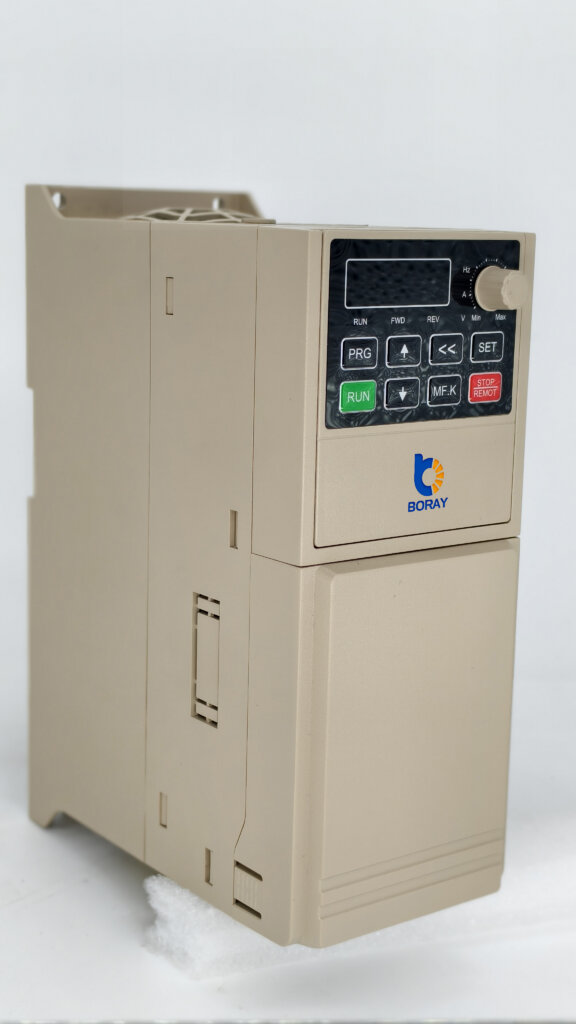
Boray Inverter (borayinverter.com) represents the convergence of advanced Chinese manufacturing and specialized engineering expertise. As a dedicated manufacturer of Solar Pump Inverters and Variable Frequency Drives, Boray offers capabilities engineered for demanding industrial applications:
- Engineering-First Organization: With 50% of our workforce dedicated to R&D, we specialize in both Permanent Magnet Synchronous Motor (PMSM) and Induction Motor (IM) vector control algorithms, ensuring optimal torque production for both ND and HD applications.
- Production Excellence: Our dual modern production lines feature 100% full-load testing protocols before delivery, ensuring every unit meets specified overload capacities (110% or 150%) under actual thermal conditions.
- Application Expertise: From agricultural solar pumping systems requiring MPPT efficiency to heavy-duty conveyor controls requiring 150% starting torque, we provide customized firmware and hardware configurations.
- Quality Assurance: Comprehensive burn-in testing and IP-rated enclosure options (up to IP56) ensure reliability in harsh environments.
For wholesale pricing, custom OEM solutions, or technical consultation on your specific ND vs. HD application requirements, contact Boray Inverter today.
Frequently Asked Questions (FAQs)
Can I use a Normal Duty VFD for a Constant Torque application if I oversize it?
Yes, but economically it is inefficient. A 40 HP ND drive may handle a 30 HP CT load because the ND drive’s 110% overload capacity on a 40 HP unit approximates the 150% capacity of a 30 HP HD unit. However, you pay for 40 HP continuous capacity you will never use. The HD-rated 30 HP drive is the correct engineering and economic choice.
Why does my VFD trip on overcurrent when starting a conveyor, even though the HP rating matches?
You are likely using a Normal Duty drive on a Constant Torque load. Conveyors require 150% starting torque to overcome static friction and load inertia. An ND drive is only rated for 110% overload, causing immediate overcurrent faults. Switch to an HD-rated drive or verify your control mode is set to Sensorless Vector Control (SVC) rather than V/Hz.
What is the difference between Sensorless Vector Control (SVC) and Flux Vector Control (FVC) for Heavy Duty applications?
SVC estimates motor rotor position mathematically without physical feedback, providing sufficient torque control for most HD applications (conveyors, mixers) at 0.1% speed accuracy. FVC requires an encoder or resolver on the motor shaft, delivering 0.01% speed accuracy and full torque at zero speed—necessary for cranes, winders, and precise positioning. FVC adds $1,000+ to system cost and complexity.
How does high altitude affect VFD duty ratings?
Above 3,300 feet (1,000 meters), air density decreases, reducing cooling efficiency. Most manufacturers require derating the drive by 1% per 100 meters above 1,000 meters, or reducing the service factor from 1.15 to 1.0. For a 30 HP HD application at 5,000 feet, you may need to specify a 40 HP HD drive to maintain the required 150% overload capacity.
Should I specify Heavy Duty ratings for solar pump inverters?
Solar submersible pumps often exhibit high starting torque requirements similar to CT loads, especially when pumping from deep wells. While centrifugal surface pumps are VT applications, submersible borehole pumps frequently require HD-rated solar inverters with 150% starting torque capability and advanced MPPT algorithms to prevent stalling during morning startup or under varying irradiance conditions.